

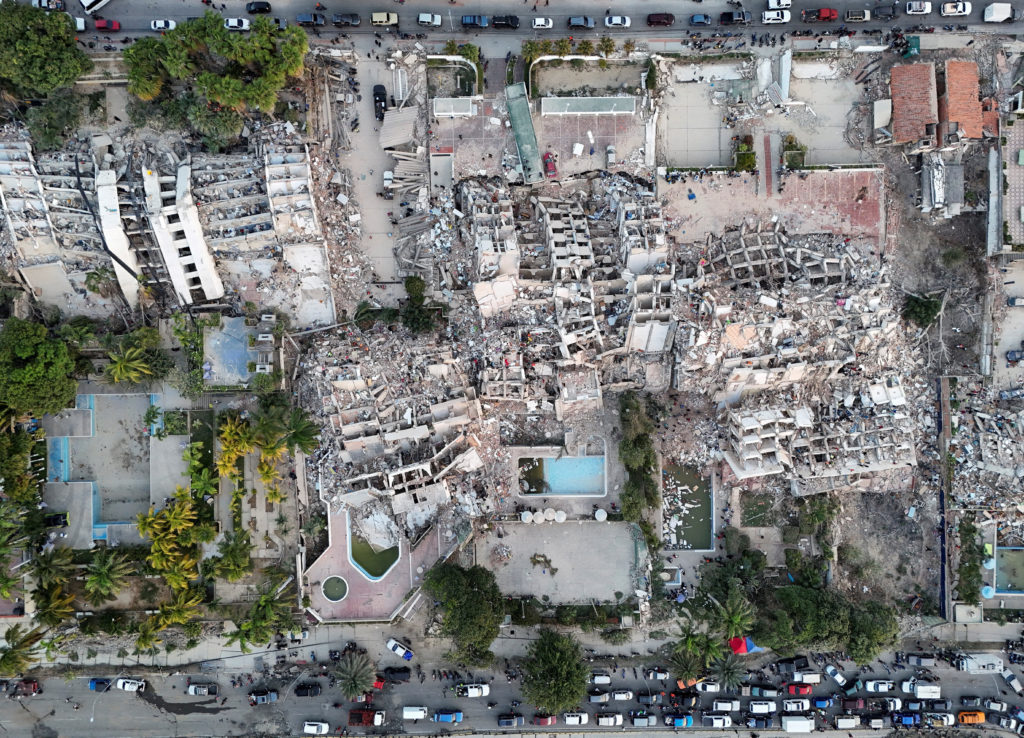
Rescue teams in Venezuela are racing to find survivors after two powerful earthquakes devastated parts of the country, killing more than 1,700 people and injuring thousands more.
ABC News reported that Venezuelan lawmaker Jorge Rodriguez said at least 1,719 people had died and 5,034 others had been injured by June 29. The figures may still rise as search and rescue operations continue.
The earthquakes struck Venezuela on June 24. The Associated Press reported that a 7.2 magnitude quake was followed 39 seconds later by a 7.5 magnitude quake, an event known as a “doublet.”
The coastal state of La Guaira, about 40 kilometres north of Caracas, is among the worst affected areas. Entire buildings collapsed into rubble, while hundreds of other structures were declared unsafe.
Rescuers Search Through Rubble
Foreign rescue teams have joined Venezuelan responders in the search for people trapped under collapsed buildings.
The operation has brought together international rescuers, civilian volunteers and local emergency teams. Many responders are working in dangerous conditions caused by aftershocks, unstable debris and limited access to heavy machinery.
Officials said thousands of people have been displaced, while families continue searching for missing relatives.
“We are in critical hours, in crucial hours to continue rescuing lives and to build camps where those people who have lost their homes can stay,” Mr Rodriguez said.
Despite the scale of destruction, rescuers have continued to report moments of hope.
At least 33 people had been pulled alive from the rubble by Saturday evening, including children. On Sunday, a father and his son were rescued from a collapsed structure.
Missing Figures Remain Unclear
The number of people still unaccounted for remains disputed.
Government figures differ from opposition-linked estimates. Officials have reported hundreds missing, while a website promoted by opposition groups listed nearly 50,000 people as unaccounted for by Sunday.
That figure had declined from about 55,000 a day earlier, suggesting that verification efforts were continuing.
Rescue experts say the chances of finding survivors usually decline sharply after the first 72 hours following a major earthquake.
“There exists a window of roughly three days where the probability decreases that you can save people alive,” said Sebastian Eugster, leader of the Swiss rescue team.
He said his team, which includes search dogs, had detected several survivors but struggled to reach them in time.
La Guaira Faces Heavy Damage
In La Guaira, rescue operations have been slowed by aftershocks, debris and the early shortage of heavy machinery.
Before international teams arrived, some families spent days digging through rubble using bare hands and basic tools.
Acting President Delcy Rodriguez said rescue and recovery work would continue despite the difficult conditions.
She also announced a presidential commission to assess the structural safety of buildings in affected areas.
Schools in La Guaira have been closed for another week. Authorities also said electricity supply had been restored to about 75 percent of affected areas.
The government has thanked civilian volunteers for helping deliver aid. However, authorities have also restricted access to some key roads, saying congestion was delaying emergency vehicles.
International Teams Join Response
International support has increased as the scale of the disaster has become clearer.
The United States, Colombia, Mexico and several European countries have deployed specialised urban search and rescue teams.
ABC News reported that more than 300 search and rescue personnel from the United States were working on the ground in Venezuela by June 29. It also reported that the U.S. had committed more than $300 million to the earthquake response.
Colombian and Mexican rescuers have also helped pull children from collapsed buildings, according to reports from the affected areas.
Many survivors have been carried out on stretchers after spending long hours trapped under debris.
Global Leaders Express Solidarity
Global leaders have expressed condolences to Venezuela as the humanitarian crisis deepens.
Pope Leo conveyed sympathy during Sunday prayers in Rome and praised rescue workers involved in the operation.
However, political tensions continue to shape the response. Opposition leader María Corina Machado has indicated plans to return to Venezuela after months in exile.
In a separate development, Venezuela’s largest refinery, Amuay, was reportedly shut down on Sunday following a major power outage in western Falcón state.
The refinery has a capacity of 645,000 barrels per day. Its shutdown has raised concern about fuel supply stability at a time when emergency services are already under pressure.