

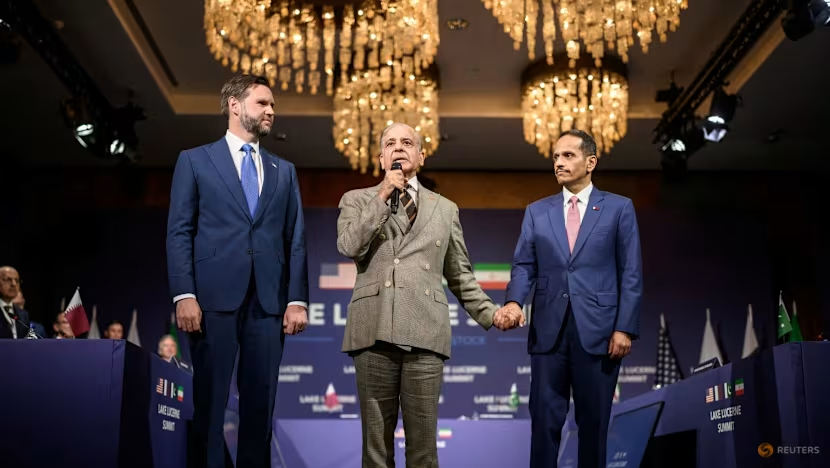
The first round of high-level talks between the United States and Iran ended in Switzerland on Monday, with mediators Qatar and Pakistan announcing a 60-day roadmap toward a final deal.
The talks opened under heavy tension after Tehran said it had again closed the Strait of Hormuz. U.S. President Donald Trump also repeated threats to resume attacks on Iran.
In a joint statement, Qatar and Pakistan said Washington and Tehran had agreed to continue technical discussions for the rest of the week.
The talks are taking place at the Qatari-owned Buergenstock resort in Switzerland.
Mediators announce roadmap
According to the joint statement, the parties agreed to a mechanism aimed at ending the fighting in Lebanon.
They also opened a communications line intended to support safe passage for commercial ships through the disputed Strait of Hormuz.
U.S. Vice President JD Vance opened talks with Iranian officials on Sunday.
The discussions followed a memorandum of understanding reached last week to extend a fragile ceasefire from April for at least another 60 days.
Talks continued into the early hours of Monday.
Iranian Foreign Minister Abbas Araqchi later said on social media that Iran had secured waivers for oil and petrochemical exports.
He also said the talks had produced the release of some frozen assets and the launch of a reconstruction and development plan for Iran.
The White House had no immediate comment when asked whether the high-level talks had ended for now.
Trump threats strain opening session
The opening was overshadowed by renewed threats from Trump.
Fox News reported that Trump said he had told Iranian officials “you won’t have a country” if they tried to close the Strait of Hormuz again.
The report also said Trump repeated an earlier threat that the United States could take over the waterway and possibly charge its own toll.
U.S. and Iranian sources gave different accounts of what followed.
Iran’s semi-official Tasnim news agency, citing an informed source, said the Iranian delegation refused to return to the room after Trump’s threats became public.
However, the source said messages continued through Pakistani and Qatari mediators.
Tasnim’s source said Iranian officials insisted that nuclear talks could only begin after other parts of the memorandum were implemented.
These included the release of frozen assets and U.S. waivers authorising Iranian oil exports.
A U.S. diplomat involved in the talks rejected claims that the Iranians had left the process.
“The Iranians never left and are still here meeting and negotiating deep into the night,” the diplomat told Reuters.
“We’ve talked about the Strait, Lebanon, nuclear issues, and details of implementing the MOU, among other topics.”
Strait of Hormuz remains key dispute
The agreement under discussion called for reopening the Strait of Hormuz and ending hostilities, including in Lebanon.
The waterway is a major route for global energy shipments.
Iran said at the weekend that it had again stopped maritime traffic through the strait.
Tehran argued that the United States had failed to meet its commitment to halt fighting in Lebanon.
Iran also said Sunday’s talks would not cover substantive issues such as its nuclear programme.
At the talks, Vance played down the effect of violence in Lebanon.
“These things are always a little bit messy,” he said.
Back in the United States, Trump threatened further action if Iran did not rein in its allies.
“Iran must immediately stop their highly paid PROXIES in Lebanon from causing trouble,” Trump wrote on social media, apparently referring to Hezbollah.
“If they don’t, we’ll hit Iran very hard again, just like we did last week, only harder!!!”
Even as Trump issued threats, Vance told reporters the U.S. president had “asked us to turn over a new leaf to transform our relationship with the people of Iran.”
A U.S. diplomat said late Sunday that discussions included “clarifying some of the confusing messaging from Iran on the Strait and building deconfliction mechanisms to ensure the Strait will remain fully open.”
Lebanon fighting complicates negotiations
Iran has cited continued violence in Lebanon as the reason for its latest move on the Strait of Hormuz.
A new ceasefire in Lebanon was announced on Friday, but there has been little evidence of a full halt in fighting.
Iran said on Saturday that the lack of progress had forced it to shut the strait again.
U.S. officials disputed the claim that the waterway had been closed.
However, commercially available shipping data showed a sharp drop in traffic.
Data from analytics firm Kpler showed that five vessels passed through the strait on Sunday, compared with 26 ships the previous day.
The data may not include vessels that switched off their transponders while moving through the Gulf.
Iran’s Fars news agency cited a military source as saying no new permits were being issued for ships to cross until further notice.
Trump said he had agreed to last week’s memorandum of understanding to prevent a global economic depression caused by high oil prices after the strait’s closure.
Oil prices had fallen over the past week to levels not seen since the war began on February 28 with U.S.-Israeli attacks on Iran.
Brent crude futures rose by more than $1 to $81.66 a barrel in early Monday trading after the difficult start to the Switzerland talks.
Residents return in parts of Lebanon
Sunday appeared to be quieter in Lebanon than recent days, with no major violence reported by nightfall.
That followed two days of heavy Israeli strikes and fire from Hezbollah fighters on Israeli positions.
More than one million people have fled their homes in Lebanon since Israel invaded in March to pursue Hezbollah fighters who fired across the border in support of Tehran.
Reuters journalists in southern Lebanon on Sunday saw some of the heaviest traffic since the memorandum was signed.
Residents were returning to their homes, while some people stood beside cars backed up on the highway and waved Hezbollah flags.
High-level discussions were expected to wrap up on Monday, while technical staff were expected to remain for further talks.