
Iran launched missile and drone attacks against United States military infrastructure across the Gulf on Thursday, July 9, 2026, following fresh American strikes on Iranian territory.
The renewed fighting further weakened a ceasefire reached about three weeks earlier and raised fears of a wider regional confrontation.
Iran said it targeted US-linked military facilities in Kuwait, Qatar, Bahrain and Jordan. Gulf states reported intercepting several missiles and drones, while regional governments renewed calls for restraint and diplomacy.
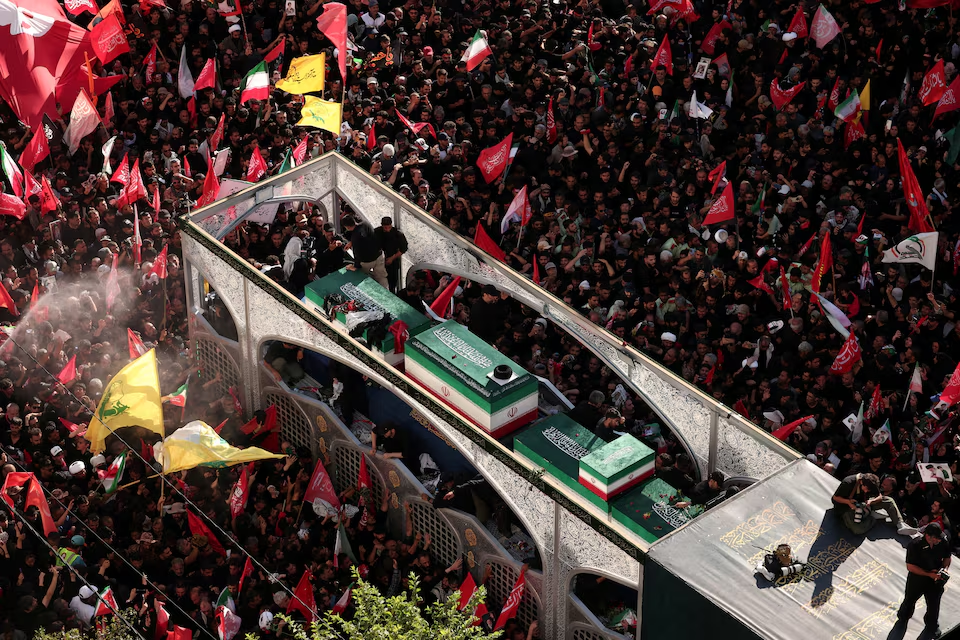
The attacks coincided with the burial of Iran’s former Supreme Leader, Ayatollah Ali Khamenei, at a shrine in Mashhad.
Khamenei died in US-Israeli airstrikes on February 28, 2026, during the opening phase of the conflict. Large crowds attended funeral events held before his burial.
Explosions reported across southern Iran
Iranian media later reported explosions in several southern locations, including Bushehr, Konarak, Choghadak and Bandar Abbas.
However, reports about the blasts remained unclear. A US official said American forces had not carried out new strikes in the preceding hours.
Iranian authorities said a projectile struck the perimeter of the Bushehr nuclear power facility. US officials had not publicly acknowledged targeting the plant.
Bushehr hosts Iran’s only operational civilian nuclear power station.
The reported incident renewed concerns about the safety of nuclear infrastructure during the conflict. Iranian authorities did not immediately report damage to the reactor itself or the release of radioactive material.
Iran claims attacks on US military facilities
Iran’s army said it attacked Patriot air-defence systems in Kuwait, an early-warning facility in Qatar and a US Army fuel depot in Bahrain.
Kuwaiti authorities said their forces engaged one cruise missile, three ballistic missiles and 10 drones. One person suffered injuries from falling debris, according to the government.
Air-raid sirens also sounded in Jordan after the military detected missiles launched from Iran.
Jordanian authorities said they intercepted eight missiles and reported no injuries or property damage.
Iran’s Islamic Revolutionary Guard Corps later claimed it had fired 10 ballistic missiles at Jordan’s Azraq military base, which US forces use, and another American military control facility in the region.
The United States had not independently confirmed damage to the sites claimed by Iran.
US says strikes targeted Iranian military assets
US Central Command said its forces had attacked about 90 Iranian military targets.
The targets reportedly included air-defence systems, coastal surveillance equipment and missile and drone storage facilities. Earlier strikes had hit more than 80 targets near the Strait of Hormuz.
US President Donald Trump said the operation responded to Iranian attacks on commercial vessels.
“This is in retribution for yesterday’s bombing of ships by Iran. If it happens again, it will get much worse!” Trump wrote on Truth Social.
Iranian state media said US attacks carried out on July 8 and 9 killed 14 people and injured 78 others across five provinces.
The Fars news agency also reported that one strike damaged a railway bridge used for trade with Russia and China.
These casualty and damage figures came from Iranian authorities and had not been independently verified.
Strait of Hormuz remains central to conflict
The latest escalation followed attacks on commercial vessels near the Strait of Hormuz earlier in the week.
Trump subsequently declared that the ceasefire was “over,” although a US official said Washington remained interested in a negotiated settlement and that technical discussions were continuing.
The Iranian Revolutionary Guard Corps accused the United States of interfering with efforts to reopen the strategic waterway.
It said shipping under Iranian supervision had recovered to about half of pre-war levels during the previous two weeks.
The Guards warned that further US intervention would receive a “crushing response.”
US Central Command rejected Iran’s claim of control over the strait.
The American military said it had helped more than 800 commercial vessels carrying about 380 million barrels of crude oil to pass through the waterway since early May.
“The Strait of Hormuz will be reopened only under Iranian arrangements, not through U.S. threats,” Iran’s lead negotiator, Mohammad Baqer Qalibaf, wrote on X.
Before the conflict, roughly one-fifth of the world’s oil supply passed through the Strait of Hormuz.
Regional governments call for diplomacy
Qatar condemned attacks on commercial shipping while calling for renewed diplomatic efforts.
The country hosts Al Udeid Air Base, the largest American military facility in the region, and has previously mediated between Washington and Tehran.
The foreign ministers of Turkey and Oman also urged both sides to avoid further escalation during separate calls with Iranian Foreign Minister Abbas Araqchi.
Araqchi later discussed the conflict with Pakistan’s army chief and accused Washington of pursuing “warmongering policies.”
Despite the renewed attacks, US officials said diplomatic contacts had not completely ended.
The continued exchange of strikes has placed the ceasefire in serious doubt and increased concerns about shipping, energy supplies and the security of Gulf states.