
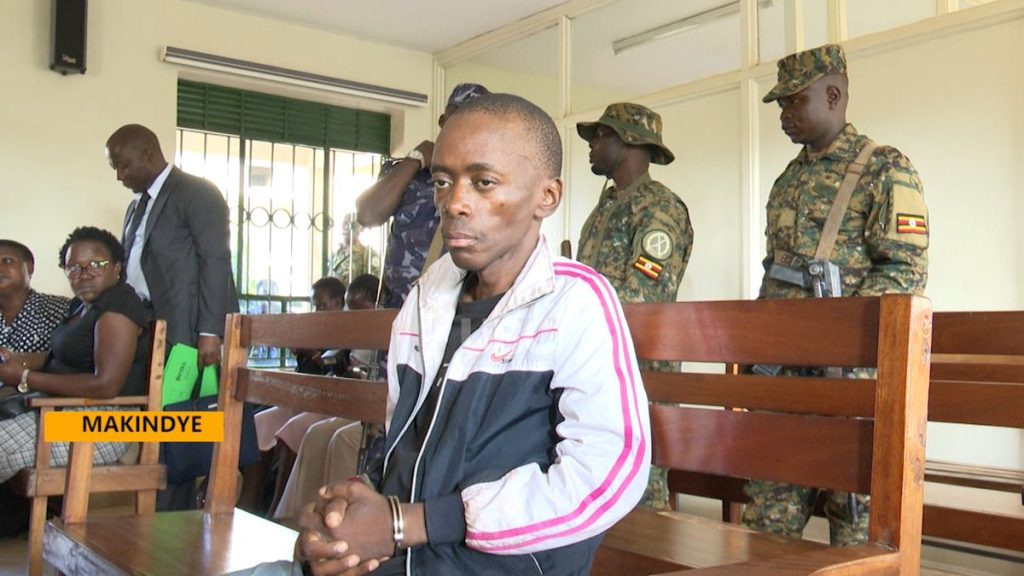
Christopher Onyum Okello, the man sentenced to death over the killing of four children at a Ggaba daycare centre, has raised three grounds of appeal as he seeks to overturn his conviction.
Okello lodged his memorandum of appeal at the Court of Appeal registry through the Uganda Law Society Legal Aid Project on Friday.
He wants the Court of Appeal to set aside his conviction or vary the death sentence imposed by the High Court.
In the first ground, Okello argues that the trial judge erred in law and fact by allegedly failing to properly evaluate the evidence. He says this led to a wrong conclusion and caused a miscarriage of justice.
In the second ground, he faults the judge for allegedly failing to evaluate medical evidence relating to his mental status.
Okello also argues that the death sentence was harsh and excessive. He wants the appellate court to set it aside or substitute it with a lesser punishment.
High Court Sentenced Okello on April 30
On April 30, High Court judge Alice Komuhangi Khaukha sentenced Okello, 39, to death after finding him guilty of killing four children at Ggaba Early Childhood Development Centre.
The killings happened on April 2.
The victims were Ryan Odeke, aged one and a half years; Keisha Agenorwoth Otim, aged two years; Gideon Eteku, aged two and a half years; and Ignatius Sseruyange, aged two and a half years.
Justice Komuhangi ruled that Okello deliberately and intentionally killed the children.
The judge rejected his defence of insanity. She relied on evidence about his conduct before, during and after the attack.
The court heard that Okello procured knives, hired a car and carried out transactions on his bank account and mobile money.
According to the judge, the prosecution evidence showed that Okello acted with intent.
Judge Rejected Insanity Defence
Justice Komuhangi said Okello had the burden to prove that he suffered from a mental illness at the time of committing the offences after choosing to rely on the defence of insanity.
She found that he did not discharge that burden.
“In the absence of any medical report and if it is true that he was suffering from the disease of the mind, his parents would have come and testified in court, but they never came to testify and even the accused never listed them among his witnesses,” the judge said.
The judge also relied on the evidence of Dr Emmanuel Nuwamanya, a Police surgeon.
Dr Nuwamanya told court that Okello appeared normal when he interacted with him. He said Okello’s speech was normal and coherent, and that he was generally calm during the interview.
Justice Komuhangi further held that even if Okello had previously been admitted to Butabika Hospital, that did not affect the case before court.
The judge said the only illness confirmed by doctors was sickle cell, which they described as a risk factor for mental illness.
After reviewing the evidence, the court also found that the defence of diminished responsibility was not available to Okello.
Diminished responsibility is a partial defence to murder. If proved, it can reduce a murder conviction to voluntary manslaughter.
Court Relied on Medical and Witness Evidence
During the trial, the prosecution relied on medical evidence, eyewitness testimony and CCTV footage.
Dr Abdul Katongole, who carried out the postmortem examinations, told court that the children died from hypovolemic shock, caused by massive blood loss from deep cut wounds on their necks.
The court also considered evidence from Phoebe Namutebi, a caretaker at the school who witnessed the incident.
The judge further considered testimony from the children’s parents.
“I am in agreement with the assessors that the prosecution proved that the four are dead,” Justice Komuhangi said.
On participation, the judge relied on CCTV footage, Namutebi’s evidence and testimony from Annet Odong, the school co-ordinator who had interacted with Okello shortly before the killings.
Justice Komuhangi noted that Okello’s participation was not contested because he did not deny killing the children.
Although the prosecution did not produce Silas Bukenya and Moses Opio, who apprehended Okello, the judge held that this did not weaken the case.
She said Okello was apprehended in the act.
On malice aforethought, the judge ruled that Okello’s conduct before, during and after the incident showed that he intentionally killed the children.
She said the prosecution proved malice aforethought because Okello did not explain the circumstances behind his actions.
What the Law Says on Death Sentences
Under Ugandan law, a death sentence passed by the High Court must be confirmed by the Supreme Court before it can be carried out.
If a person sentenced to death does not appeal, the law still requires the Supreme Court to review the case for confirmation within 30 days of conviction.
The Supreme Court may confirm the sentence, overturn it or impose a lesser sentence such as life imprisonment.
If the Supreme Court confirms the death sentence, the matter is forwarded to the advisory committee on the Prerogative of Mercy.
The committee advises the President, who is mandated under the law to sign death warrants.
Where a death sentence is not carried out within three years after confirmation by the Supreme Court, it is commuted to life imprisonment.
Judiciary Says Hearing Preparations Are Underway
Judiciary spokesperson James Ereemye Mawanda said preparations for the hearing of Okello’s appeal are underway.
“We shall update you when the matter has been fixed for hearing. So, the public should remain calm and patient,” Mawanda said.