
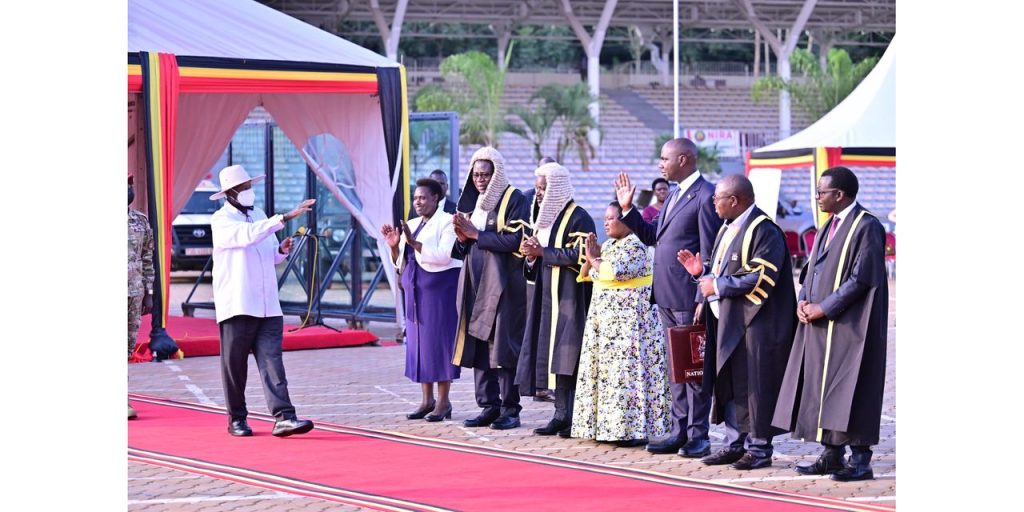
The government has unveiled its budget priorities for the 2026/27 financial year, placing major focus on economic transformation under the Ten-Fold Growth Strategy.
Finance Minister Henry Musasizi presented the budget on June 11 at Kololo Ceremonial Grounds.
The budget channels trillions of shillings into agriculture, tourism, minerals, science, infrastructure, health, education and industrial development.
It also introduces several tax measures aimed at improving domestic revenue mobilisation.
The government says the spending plan will be implemented through the Agro-Industrialisation, Tourism, Minerals and Science framework, also known as ATMS.
Agriculture gets record allocation
The government has allocated Shs2.26 trillion to the Agro-Industrialisation Programme.
Officials say this is the highest funding ever provided to the sector.
The funds will support agricultural research, innovation and commercialisation of the anti-tick vaccine.
They will also support irrigation, water for production, extension workers, quality inputs, post-harvest handling and storage.
Other priorities include agro-processing, value addition, quality assurance and market expansion.
The government says it wants Uganda to move from exporting raw agricultural commodities to selling processed and value-added products.
Tourism receives Shs567.32b
The tourism sector has received Shs567.32 billion in the 2026/27 budget.
The allocation will support branding and marketing of Uganda as a tourism and investment destination.
It will also fund tourism infrastructure, highway sanitation facilities, refreshment centres, hospitality training and standards enforcement.
Other priority areas include wildlife conservation, health tourism and economic diplomacy.
The government says the investment will strengthen Uganda’s competitiveness as a tourism destination.
Minerals, oil and gas prioritised
The government has allocated Shs473.51 billion to mineral-based industrial development, mining, oil and gas.
The funds will support mineral exploration, certification and capitalisation of the Uganda National Mining Company.
They will also support the establishment of mineral markets and buying centres.
In the oil and gas sector, the money will help operationalise the East African Crude Oil Pipeline and develop the national oil refinery.
Officials say the goal is to turn Uganda’s mineral resources into industrial wealth through processing and value addition.
Digital economy and innovation receive Shs1.14t
The government says investment in digital infrastructure continued to deliver results during the year.
An additional 879 kilometres of fibre optic cable were installed.
This brought the national fibre backbone to about 62,941 kilometres.
Internet costs declined from $70 to $35 per megabit per second.
Mobile internet subscriptions reached 18.5 million.
Smartphone connections rose to 20 million, while total mobile telephone subscriptions reached 57.3 million.
Mobile money transactions increased by 29 percent to Shs392.7 trillion in the year ending March 2026.
Active mobile money accounts also reached 36.7 million.
For the 2026/27 financial year, the government has allocated Shs1.14 trillion to Science, Technology and Innovation, ICT and the creative industries.
Key projects include commercialisation of Kiira Motors vehicles, Dei BioPharma products, and value-added coffee and banana products.
The money will also support the establishment of a Hi-Tech City, research and development, digital infrastructure and business process outsourcing.
Other priorities include free-to-air television expansion and stronger protection of intellectual property rights.
Security and rule of law get Shs10.21t
The government has allocated Shs10.21 trillion to security, governance and rule of law institutions.
The funds will support modernisation of the Uganda People’s Defence Forces.
They will also help complete the National Referral Military Hospital and UPDF Headquarters.
Other priorities include border security, counter-terrorism, community policing, cybersecurity and immigration services.
The allocation will also support anti-corruption efforts and cattle restocking in Acholi, Lango and Teso sub-regions.
Transport infrastructure gets Shs8.79t
Transport infrastructure remains a major budget priority.
The sector has received Shs8.79 trillion for key projects across the country.
The funds will support construction of the Malaba–Kampala Standard Gauge Railway and rehabilitation of the Meter Gauge Railway.
They will also support road and bridge construction, road maintenance and expansion of water transport systems.
Other priorities include operationalisation of Kabalega International Airport, upgrading regional aerodromes and expansion of Uganda Airlines.
Energy sector receives Shs2.07t
The government has allocated Shs2.07 trillion to energy development.
The funds will support construction of the 380-megawatt Kiba Hydroelectric Power Plant.
They will also fund a floating solar power facility at Isimba and utility-scale solar projects in Elgon and Acholi.
Other planned interventions include preparatory work for nuclear energy generation in Buyende.
The allocation will also support transmission networks, rural electrification and power connections for industries.
Health sector allocated Shs5.23t
The health sector has received Shs5.23 trillion.
The money will support maternal and child health, nutrition, immunisation and treatment of non-communicable diseases.
It will also support essential medicines, specialised healthcare, emergency response systems and Universal Health Coverage efforts.
The government also reaffirmed its commitment to increasing domestic financing for essential medicines.
Officials say this will reduce dependence on donor support.
Water and sanitation receive Shs1.013t
The government has allocated Shs1.013 trillion to water and sanitation.
The funds will support expansion of access to safe water and improved sanitation services.
According to the government, 71 percent of households currently have access to improved water sources.
Coverage stands at 68 percent in rural areas and 74.5 percent in urban areas.
Education, skills and sports get Shs6.66t
The education sector has received Shs6.66 trillion.
The funds will support Universal Primary Education and Universal Secondary Education.
They will also strengthen STEM, vocational education, teacher training and curriculum reforms.
Other priorities include public universities, research institutions and sports infrastructure ahead of AFCON 2027.
The government has also allocated an additional Shs568.65 billion for salary enhancements.
The money will benefit primary school teachers, arts teachers in secondary schools and teachers in BTVET institutions.
Social protection receives Shs173.55b
The government has allocated Shs173.55 billion to social protection programmes.
The funds will support economic empowerment, labour standards enforcement and youth employment.
They will also promote women’s economic participation and strengthen social protection systems.
Part of the allocation will support the establishment of a Labour Market Information System.
Overall, the government has allocated Shs13.56 trillion to health, education, water and sanitation, and social protection.
Manufacturing and industry receive Shs1.03t
Manufacturing and industrial development have received Shs1.03 trillion.
The allocation will support additional capitalisation of the Uganda Development Corporation.
It will also fund industrial park development and value addition to agricultural and mineral products.
Other priorities include market access for local goods, Special Economic Zones and regional industrial incubation hubs.
The government says the number of formal factories in Uganda has risen to 10,437.
Of these, 690 operate within industrial parks.
Environment and disaster response funded
The government has allocated Shs494.08 billion to environmental protection and climate resilience.
The money will support protection of 1.26 million hectares of forests and wetlands.
It will also fund restoration of 10,000 hectares of degraded wetlands.
Other priorities include demarcation of riverbanks and lakeshores.
The funds will also improve weather forecasting and early warning systems.
In addition, Shs361.88 billion has been allocated to the Contingency Fund for disaster response.
Justice and Parliament allocations announced
The administration of justice has received Shs665.55 billion.
The funds will support recruitment of judicial officers, reduction of case backlog and court digitisation.
They will also support anti-corruption efforts and wider access to justice.
Parliament has been allocated Shs1.23 trillion.
The money will support its constitutional roles of legislation, appropriation, oversight and representation.