
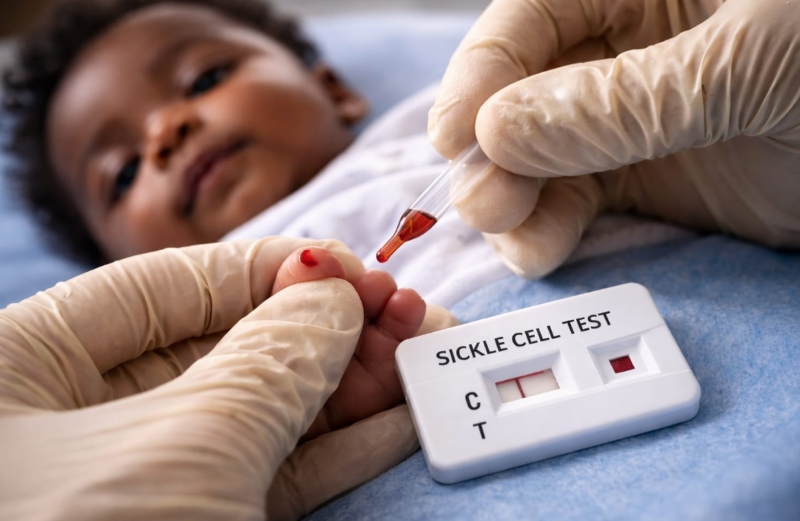
Sickle cell disease contributes nearly 16 percent of all deaths among children below five years in Uganda, the Ministry of Health has said.
Health officials estimate that about 20,000 babies are born with sickle cell disease in Uganda every year.
Of these, between 6,000 and 9,000 die before reaching their fifth birthday.
The figures were released on June 18 ahead of World Sickle Cell Day.
Speaking at the Ministry of Health headquarters in Kampala, the Director General of Health Services, Dr Charles Olaro, said improving survival among affected children is key to reducing under-five mortality.
“It is estimated that about 20,000 newborns are born each year with sickle cell disease and about 6,000 to 9,000 of them die before their fifth birthday. This contributes to 16 percent of under-five mortality which is a slight increase from the 2024 statistics [15 percent],” Dr Olaro said.
Millions carry sickle cell trait
Dr Olaro said an estimated six to seven million Ugandans carry the sickle cell trait.
He said this increases the risk of children inheriting the disease.
“If we have to change the trajectory of under-five mortality, then it means that we have to improve the care and survival of children who are living with sickle cell disease. Also approximately six to seven million people nationwide are carrying the sickle cell trait which puts every newborn at risk of transmission,” he said.
Uganda is ranked among countries with the highest number of people living with sickle cell disease globally.
The Ministry of Health attributes the burden to the widespread presence of the sickle cell gene.
According to the ministry, about 13 in every 100 Ugandans carry the sickle cell trait.
In some parts of northern and eastern Uganda, the prevalence rises to about 20 percent.
Some regions carry heavier burden
Dr Sarah Kiguli, a paediatrician at Mulago Hospital, said sickle cell disease is now present across the country.
However, she said some regions still record higher prevalence.
“The high-burden regions include Acholi, Lango, central Uganda and south-western Uganda,” she said.
To reduce new cases, the Ministry of Health has intensified newborn screening.
It is also promoting premarital testing to help couples understand their genetic status before having children.
Dr Mariam Ajambo, the National Coordinator for Sickle Cell Disease at the Ministry of Health, said knowing one’s sickle cell status remains important in prevention.
“Before anyone gets a child, they should know their partner’s status regarding the sickle cell trait so that carriers do not marry fellow carriers. That is the ultimate way through which we can fight this disease and eradicate it,” Dr Ajambo said.
She said the ministry is expanding community screening services.
The focus is on rural and hard-to-reach areas, where early diagnosis and treatment access remain limited.
Treatment gaps remain a concern
Health officials say access to essential medicines remains a major challenge in managing sickle cell disease.
Dr Olaro said health facilities should include Hydroxyurea in their annual procurement plans.
Hydroxyurea is used to reduce complications linked to sickle cell disease.
“The hospitals have to include it in their plans so as to be considered during the supply of medicines because it is an essential medicine. Once we have accurate data, we can quantify how much Hydroxyurea is needed and the resources required,” he said.
Sickle cell disease is an inherited blood disorder.
It affects the shape and function of red blood cells.
The condition can cause severe pain episodes, anaemia, organ damage and other health complications.
Experts say early diagnosis, treatment access and public awareness are critical to reducing deaths.
They also say these measures can improve the quality of life of people living with the disease.
Survey shows regional differences
Data from the 2024 sickle cell disease survey shows different prevalence levels across Uganda.
East-Central Uganda recorded a disease prevalence of 1.5 percent.
This region includes Busoga, Bugweri, Bukedi and parts of Teso.
The Mid-North regions of Acholi and Lango recorded 1.3 percent.
Mid-Eastern Uganda recorded 1.2 percent, while North-East Uganda stood at 1 percent.
Central Uganda recorded 0.8 percent, while Kampala recorded 0.7 percent.
Mid-Western Uganda and West Nile each recorded 0.5 percent.
South Western Uganda recorded the lowest prevalence, at 0.2 percent.
According to the 2024 Annual Health Performance Report, sickle cell disease ranks 12th among the leading causes of admissions in health facilities.
It accounts for 1.5 percent of admissions.