
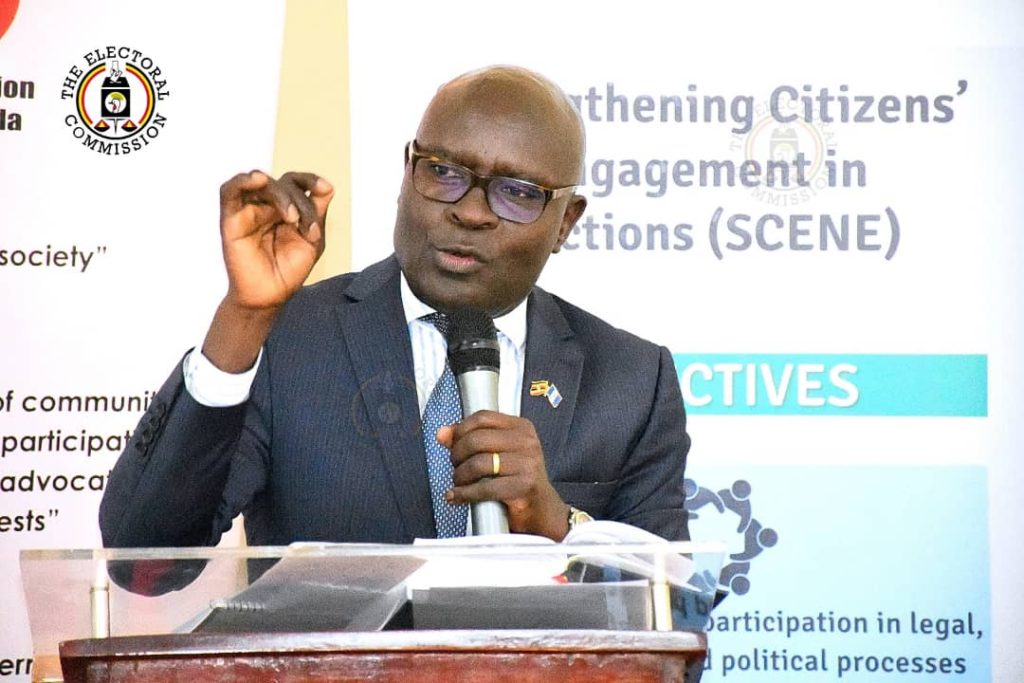
The Electoral Commission has received sh56b from the finance ministry to organise the long-awaited LC1, LC2 and village women council elections across Uganda.
Finance ministry deputy secretary to the Treasury Patrick Ocailap confirmed that the funds were released on Friday, June 12. He said the next step now rests with the Electoral Commission.
“We released the required money to conduct the elections on Friday [June 12]. The ball is now in the Electoral Commission’s court,” Ocailap told New Vision by phone.
EC secretary Richard Kamugisha also confirmed receipt of the money. He said the commission will meet to fix the election dates.
“Yes, we have now received the funds. It is on our system. We are working on fixing the dates for the elections. The commission will sit on Monday next week and fix the dates,” Kamugisha said.
EC Says Roadmap Is Ready
Kamugisha said the Electoral Commission had been prepared to conduct the elections since the end of the general election in February.
“The commission had planned that the LC elections would be conducted in March, unfortunately we never got the money,” he said.
EC chairperson Justice Simon Byabakama said the delay had been caused by lack of funding. He added that the roadmap is already in place.
“It’s the issue of money that has been holding us back. But we shall fix the dates within less than a week because we got ready long time ago,” Byabakama said.
The release of the money now opens the way for full preparations for the grassroots elections. The polls had been delayed several times, raising concerns about governance gaps in villages and parishes.
LC Terms Expired in 2023
The current LC1 and LC2 leaders were elected in 2018. Their term officially expired in 2023.
Parliament has since extended their tenure six times, with each extension lasting six months.
Uganda has more than 70,000 villages. LC1 structures act as the first point of contact between citizens and the central government.
They handle land and family disputes, certify residents for government programmes, support local security and mobilise communities for immunisation, census and development activities.
MPs Raised Concern Over Delays
Earlier this year, former ICT and national guidance minister Chris Baryomunsi said Cabinet had approved holding the elections in March.
However, finance ministry officials said there was no money at the time.
President Yoweri Museveni later directed the finance ministry during a Cabinet meeting to mobilise resources for the exercise.
The ministry later presented a supplementary budget to Parliament. It included funds for the LC elections.
Parliament approved the supplementary budget in April, but the money had not been released until June 12.
The then Speaker of Parliament, Anita Among, and several MPs had urged the Government to proceed with the LC elections.
Kiboga East MP Keefa Kiwanuka raised the matter during plenary in April. He said previous promises had indicated the elections would take place in March and April.
“At the time, the minister of state for local government confirmed that elections would proceed and that funds had been released. It has now been over a month without a response,” Kiwanuka said.
He warned that further delays could affect grassroots governance.
“These local leaders perform critical functions, including handling land disputes, addressing domestic violence cases, mobilising communities and supporting security and intelligence efforts,” Kiwanuka said.
Kiwanuka also criticised the poor facilitation of LC chairpersons, who receive sh10,000 per month.
He said holding the elections would restore legitimacy to village leadership structures that have served beyond their original mandate.
EC to Recruit 142,500 Polling Officials
Kamugisha said the Electoral Commission plans to recruit 142,500 polling officials for the exercise.
The officials will support voter verification, register display, crowd management, declaration of lining-up procedures and tallying of results.
For voter register display and other pre-election activities, the EC will deploy one official in each of the 71,250 villages.
On polling day, the commission will deploy two officials per village. This will bring the number of temporary election workers to 142,500.
Sources said each official is expected to earn sh10,000 per day. Total earnings will depend on the number of days worked.
The recruitment is expected to create short-term employment for thousands of Ugandans, especially youth and unemployed people who have previously worked in election-related activities.
EC Explains Election Cost
Kamugisha defended the cost of the exercise, saying polling day is only one part of the process.
“Lining up is just one of the activities. The process involves more than lining up. It involves compiling the register and printing registers for each village. There are 71,250 villages. It involves displaying the register physically, cleaning it and allowances,” Kamugisha said.
He said the commission must follow the law to avoid disputes.
“The election is conducted according to the law. When the law says we print registers, recruit polling officers and other things, we have to do them, and all of them require money. Otherwise, if you don’t conduct the elections according to the law, the results will be contested and you will be taken to court,” Kamugisha said.
LC Chairperson Reflects on Service
Godfrey Birungi, the LC1 chairperson of Rwengoma 2B in Kabarole district, said he has served in the position for 27 years.
However, Birungi said he views the role as public service rather than employment.
“I don’t consider what I do as a job. It is a service to the people. That explains why people still love me. Since I am busy doing other work, I decided to give the stamp to my vice chairman,” Birungi said.