
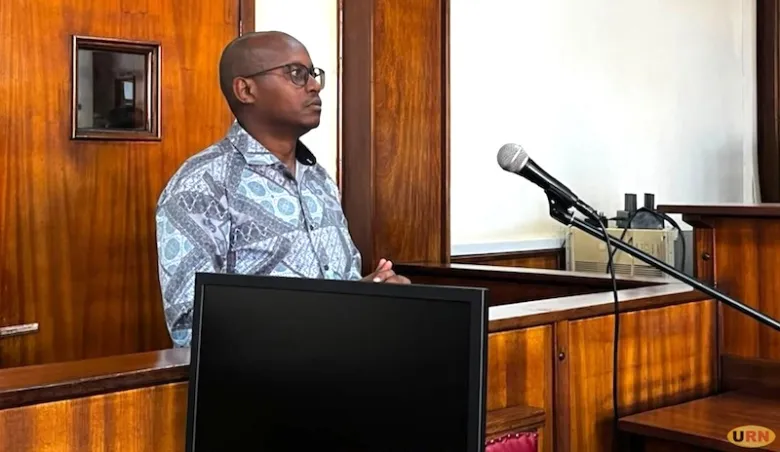
Former African Union policy adviser Michael Katungi Mpeirwe has been remanded to Luzira Prison as Uganda begins extradition proceedings requested by the United States government.
Katungi is wanted in the United States over allegations linked to drug trafficking, illegal arms transactions and terrorism-related offences.
He appeared before Chief Magistrate Ritah Neumbe Kidasa on Monday after police executed a warrant of arrest issued on June 23, 2026.
Court heard that the warrant was issued to secure his attendance as Uganda begins the process of considering the U.S. request.
Katungi was arrested over the weekend.
Until last year, he served as commissioner for external affairs and a member of the Central Committee of the Patriotic League of Uganda, the political organisation led by Chief of Defence Forces Gen Muhoozi Kainerugaba.
Katungi Opposes Extradition
State attorneys Adrian Asingwire and Joan Keko represented the Ugandan government.
They told court that the U.S. request is based on the 1988 United Nations Convention Against Illicit Traffic in Narcotic Drugs and Psychotropic Substances.
The state said Uganda is required to process requests for surrender of suspects wanted for prosecution in foreign jurisdictions.
When asked to respond, Katungi told court that he opposed extradition to the United States.
His lawyers, led by Samuel Kakande, and assisted by Ramadhan Akatwijuka and Musa Nsamba, also challenged the process.
They said they would raise preliminary objections on the legality of the extradition proceedings.
The defence argued that Katungi and his legal team had not received the documents the state intends to rely on.
They said this had denied them enough time to prepare a response.
The lawyers also applied for his release on bail pending the hearing of the extradition request.
State Says Bail Application Is Premature
State attorney Adrian Asingwire opposed the defence applications.
He said Katungi’s lawyers had misunderstood the stage of the proceedings.
According to the prosecution, the warrant was only meant to bring Katungi before court.
Asingwire said the court had not yet considered the merits of the extradition request.
The state told court that Katungi’s first appearance was meant to establish whether he would consent to extradition or challenge it.
After Katungi rejected extradition, the prosecution asked court to set an early hearing date.
The state said this would allow it to file and argue the formal extradition application.
Prosecutors also argued that the bail and disclosure applications were premature because the formal extradition hearing had not yet started.
Defence lawyer Musa Nsamba disagreed.
He said no formal extradition application had been filed. He also argued that the state had relied on ex parte proceedings to obtain the arrest warrant.
Nsamba asked court to release Katungi unconditionally.
Court Sets July 10 Hearing
In her ruling, Chief Magistrate Kidasa held that Katungi had been lawfully produced in court under a valid warrant.
She said the warrant had been issued to secure his attendance for the start of extradition proceedings.
The magistrate declined to grant bail at the preliminary stage.
She directed the prosecution to file the formal extradition application by July 1, 2026.
The defence was ordered to file its response by July 7.
The matter was adjourned to July 10 for hearing of the extradition application.
Katungi was remanded to Luzira Prison until then.
U.S. Indictment Names Four Suspects
According to the U.S. indictment, Katungi is accused alongside Bulgarian national Peter Dimitrov Mirchev, Kenyan national Elisha Odhiambo Asumo and Tanzanian national Subiro Osmund Mwapinga.
The indictment alleges that the four conspired to distribute and possess with intent to distribute five kilograms or more of cocaine.
U.S. prosecutors allege that the accused knew, or had reasonable cause to believe, that the drugs would be unlawfully imported into the United States.
They are also accused of conspiring to possess firearms, including machine guns and destructive devices, in furtherance of a drug trafficking offence.
The indictment further alleges conspiracy to provide material support to a designated foreign terrorist organisation.
The allegations have not been tested in the Ugandan extradition hearing, and Katungi has opposed being surrendered to the United States.
Alleged CJNG Arms Plot
The U.S. Attorney’s Office alleges that from at least September 2022, the suspects conspired to supply military-grade weapons to the Cartel de Jalisco Nueva Generación, commonly known as CJNG.
The cartel is one of Mexico’s most powerful transnational criminal organisations.
The alleged weapons included machine guns, rocket launchers, grenades, sniper rifles, anti-personnel mines, night-vision equipment, anti-aircraft weapons and surface-to-air missile systems.
U.S. authorities allege that the suspects believed the cartel would use the weapons to support large-scale cocaine trafficking into the United States.
On February 20, 2025, CJNG was designated a Foreign Terrorist Organisation under the U.S. Immigration and Nationality Act.
It was also designated a Specially Designated Global Terrorist under Executive Order 13224.
According to the indictment, Mirchev allegedly recruited Asumo to obtain a fraudulent End-User Certificate from an African country.
Prosecutors allege the document was intended to conceal the final destination of the weapons.
The indictment further alleges that Asumo recruited Katungi, who then recruited Mwapinga.
Prosecutors say the group obtained an end-user certificate from Tanzania authorising the importation of AK-47 rifles.
Using that documentation, Mirchev and others allegedly exported a test shipment of 50 AK-47 assault rifles, magazines and ammunition from Bulgaria.
U.S. authorities allege that the weapons were intended to reach CJNG.
The indictment also claims the group later planned to supply weapons worth about €53.7 million, equivalent to about Shs224 billion.
The alleged package included anti-aircraft systems and drones.
Prosecutors further allege that falsified arms control documents would be used to hide the true end user.
Court records also indicate that Mirchev had previously been implicated in supplying arms to convicted international arms trafficker Viktor Bout.