
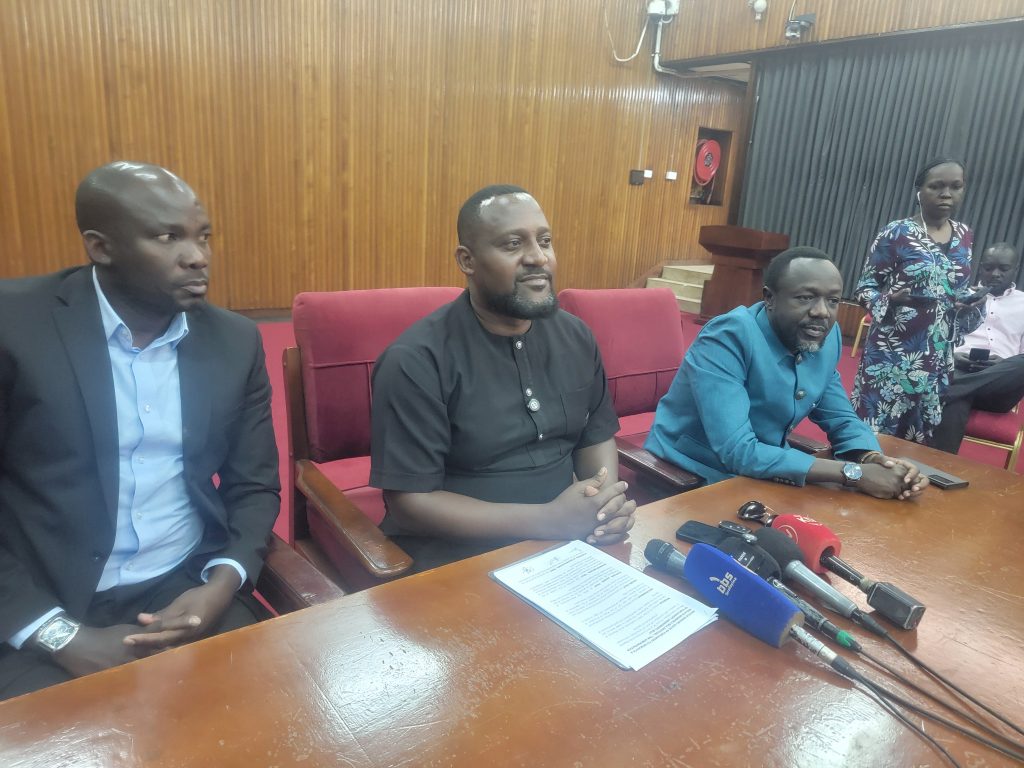
Parliament has granted Buyaga West MP Dennis Namara permission to introduce a Private Member’s Bill seeking to amend the Administration of Parliament Act, opening a fresh debate on how Uganda’s Leader of the Opposition is elected and held accountable.
The proposed Administration of Parliament Amendment Bill seeks to allow all opposition MPs to participate in electing the Leader of the Opposition, instead of leaving the decision to the largest opposition party.
It also proposes wider grounds for removing the Leader of the Opposition, including incompetence and misconduct.
Tayebwa Explains Ruling on Private Member’s Bill
The decision came after a lengthy procedural debate in Parliament. Deputy Speaker Thomas Tayebwa ruled that Namara’s request had met the constitutional and procedural threshold required for a Private Member’s Bill.
Tayebwa said the Speaker’s role at the leave stage is limited. He explained that presiding officers only check whether a proposed Bill violates constitutional provisions.
He said the chair considers whether the draft would breach Article 93 on financial matters, infringe non-derogable rights, or seek to establish a one-party political system.
“The moment we find that you conform to those provisions, as presiding officers, our hands are tied,” Tayebwa said.
He added that Parliament, not the presiding officer, decides whether to grant leave to a member.
Tayebwa also clarified that Namara did not need a certificate of financial implications at this stage. He said the certificate becomes necessary before the Bill is tabled for first reading after drafting.
Opposition MPs Question Timing and Motive
Before Namara moved his motion, several opposition MPs questioned whether Parliament should revisit proposals similar to those discussed during the 11th Parliament.
Kassanda South MP Patrick Nsamba Oshabe said political parties had already expressed views on related amendments. He asked whether it was proper to reopen the matter.
Other MPs questioned whether the proposal reflected the priorities of Namara’s constituents.
However, Tayebwa rejected attempts to question the MP’s political motivation. He said every legislator has a constitutional right to introduce a Private Member’s Bill.
“I don’t think any member has a right to be told how his constituents will react or not, because he knows the constituents he represents,” Tayebwa said.
He warned MPs against intimidating colleagues who seek to exercise their legislative mandate.
Namara Says Bill Seeks Democratic Reform
Namara moved his motion under Articles 79 and 94 of the Constitution and the Rules of Procedure of Parliament.
He argued that the Administration of Parliament Act needs reform to strengthen accountability and democratic governance inside Parliament.
Namara said the current system gives the largest opposition party excessive control over decisions that affect all opposition MPs.
He said Uganda adopted multiparty politics in 2005, but the law still allows one opposition party to dominate the selection of the Leader of the Opposition.
“We are talking about anchoring democracy. Democracy cannot only be on the side of the National Resistance Movement. Democracy should be on two sides,” Namara said.
He also questioned why ministers and other public officials face accountability mechanisms while the Leader of the Opposition does not.
“If every minister of the Government of Uganda can be censured because they draw money from the Consolidated Fund, how come there are no checks and balances on the side of the Leader of the Opposition?” he asked.
Bill Seeks Wider Consultation in Opposition Leadership
The proposed Bill also seeks to require broader consultation among opposition parties when appointing the shadow cabinet.
It further proposes more inclusivity in appointing opposition representatives to parliamentary committees and international bodies.
Linos Ngopek, who seconded the motion, said the Administration of Parliament Act provides for the election of the Leader of the Opposition but does not clearly state the procedure.
He argued that the current practice gives the largest opposition party power to designate the Leader of the Opposition. He said this limits smaller opposition parties and independent MPs.
Ngopek said allowing all opposition legislators to elect the LoP would promote inclusivity and strengthen internal democracy.
He added that stronger accountability measures would improve transparency in the office.
Adeke Asks for Evidence on Consultation Claims
Soroti District Woman MP Ann Adeke Ebaju questioned whether the claims supporting the amendments had been substantiated.
She asked Namara to provide evidence that other opposition parties had not been consulted during the appointment of the current Leader of the Opposition, Joel Ssenyonyi.
Tayebwa said such matters would be handled when the Bill is formally introduced and debated on its merits.
He said Parliament was only deciding whether Namara should be allowed to prepare and introduce the legislation.
The House later granted Namara leave to introduce the Administration of Parliament Amendment Bill.
The Bill will now be drafted. It must also obtain a certificate of financial implications before it returns to Parliament for first reading and formal consideration.
The proposal comes amid heightened political debate around the Office of the Leader of the Opposition.
That debate intensified after recent public exchanges between LoP Joel Ssenyonyi and Chief of Defence Forces Gen. Muhoozi Kainerugaba.
Ssenyonyi had questioned the military’s role following the arrest of former Kampala Lord Mayor Erias Lukwago. His remarks drew threats from Muhoozi.
Namara, however, did not directly link his proposed amendments to those events while presenting his motion.