
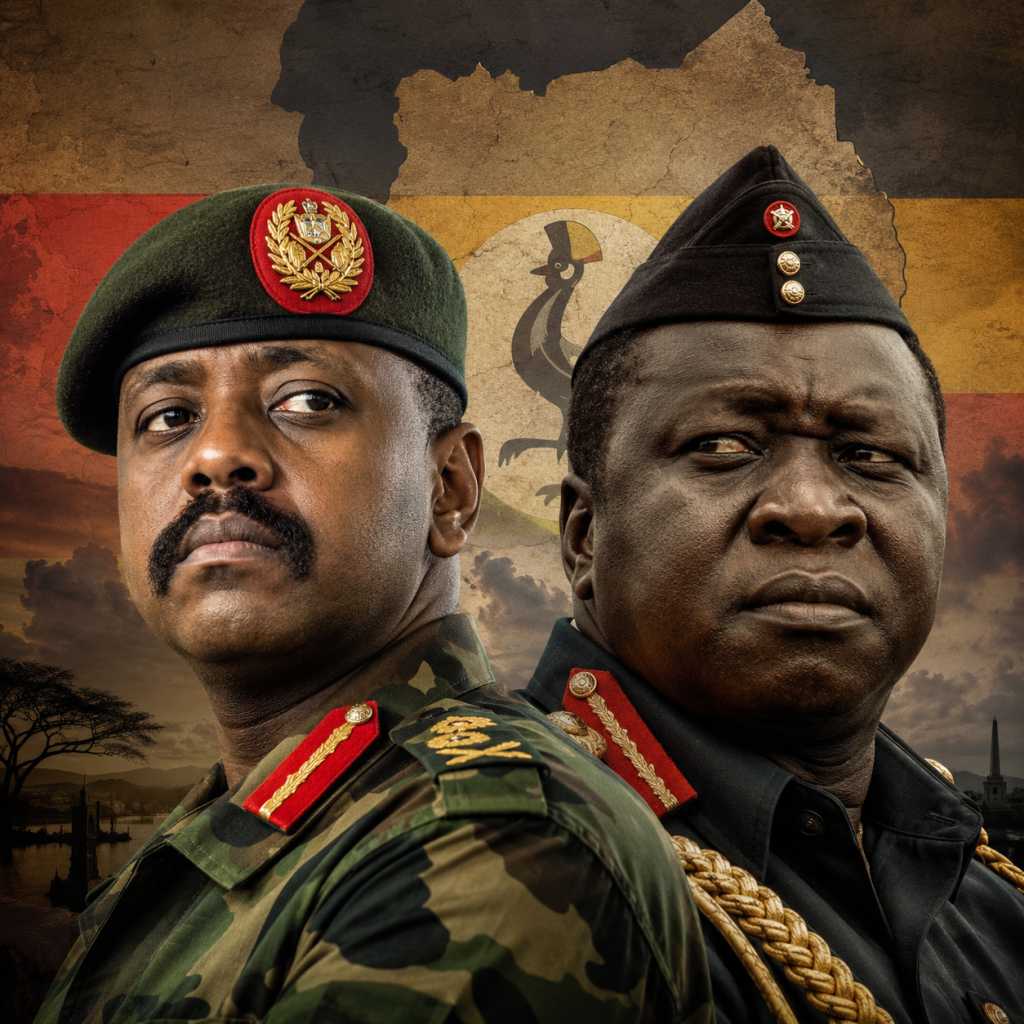
Lumumba Amin, the son of former president Field Marshal Idi Amin Dada, has urged Ugandans to stop comparing the actions of Chief of Defence Forces Gen Muhoozi Kainerugaba with his late father’s rule.
His remarks come amid public debate over the reported arrest of former Kampala Lord Mayor Erias Lukwago.
Several opposition figures have compared recent security operations involving opposition politicians to the 1970s “panda gari” era.
Critics have also linked the latest events to Uganda’s history of state abductions, political killings, abuse of power, shrinking civic space and governance failures under past military rule.
However, Lumumba said Gen Muhoozi’s actions should be assessed independently.
He said the main issue should be whether state agencies acted within Uganda’s Constitution and the law.
Lumumba says facts should guide debate
On Monday, soldiers believed to be attached to the Special Forces Command reportedly raided Mr Lukwago’s home.
They allegedly scaled the perimeter wall before taking him into custody.
Gen Muhoozi later appeared to take responsibility for the operation on social media.
He linked the action to Mr Lukwago’s long-standing criticism of him and the attempt to serve him court summons.
The incident triggered comparisons with the Idi Amin era.
But Lumumba said his father should not be blamed for actions carried out by other people.
“A lot of people have been making comments and, all of a sudden, mentioning my late father, President Idi Amin, in something that he is not even responsible for,” Lumumba said.
“He is not even here. I am a bit perturbed by this sort of association of his name with other people’s actions.”
Lumumba said public discussion should focus on the legal basis for Mr Lukwago’s arrest.
“If you want to know what the Amin position is on such an incident, the first thing is: What was he arrested for?” he asked.
“What exactly is the crime? Under the laws of Uganda, what offence did he commit? What is the evidence? Those are the facts that should be made public.”
He said transparency is necessary to preserve public trust in the criminal justice system.
“Even if he is later released for one reason or another, there must be clarity about exactly why he was arrested. It should be clear that he was not arrested arbitrarily or as an abuse of power.”
Constitutional questions raised
Lumumba’s comments have renewed attention on constitutional safeguards governing arrest and detention in Uganda.
Article 23 of the 1995 Constitution guarantees the right to personal liberty and prohibits arbitrary arrest.
It also requires an arrested person to be informed immediately of the reasons for arrest in a language they understand.
The same article requires suspects to be produced before a competent court within 48 hours.
Article 28 guarantees the right to a fair hearing.
Article 20 obliges all state organs and public officials to respect, uphold and promote constitutional rights and freedoms.
The Criminal Procedure Code Act also requires arrests to be based on lawful authority, reasonable suspicion and recognised criminal offences.
Lumumba said every arrest must be tied to a clear offence.
“You cannot arrest anybody without having clear legal reasons to do so. It must relate to an offence recognised under the laws of Uganda, together with the evidence supporting that allegation,” he said.
“I ask the public to be patient and wait for the details. We need to know precisely what offence the former Lord Mayor is alleged to have committed, and then we can discuss the matter from an informed position.”
He also appealed to Uganda’s international partners to wait for the facts.
“Even the country’s foreign partners are concerned about these issues. Why they are concerned is another debate, but I ask everyone to wait for the facts,” he said.
Opposition leaders reject Lumumba’s caution
Lumumba’s appeal contrasted with reactions from opposition leaders.
They argue that the reported arrest reflects a pattern of repression similar to abuses associated with Uganda’s authoritarian past.
Former Kira Municipality MP and People’s Front for Freedom spokesperson Ibrahim Ssemujju Nganda welcomed Mr Lukwago’s transfer to Luzira Prison.
He said detention in a recognised prison offered more legal protection than alleged military custody.
Mr Ssemujju recalled the detention of the late Hajji Aziz Kasujja during Idi Amin’s administration.
He said military officers at the time reportedly told Kasujja that prison was safer than remaining in military detention.
“Today, we find ourselves relieved that Lukwago is in Luzira rather than allegedly being held under military custody,” he said.
He described the comparison as a sign of growing public anxiety over extra-judicial detention.
Bobi Wine compares methods to past abuses
National Unity Platform president Robert Kyagulanyi, also known as Bobi Wine, made a sharper comparison between the current government and Uganda’s military past.
Mr Kyagulanyi accused the government of using methods similar to those associated with Idi Amin’s feared State Research Bureau.
“You can abduct and torture him, but you cannot break his resolve,” Kyagulanyi said.
He argued that repression exposes institutional weakness rather than political strength.
He also said Uganda’s “liberators” had adopted tactics they once condemned.
Mr Kyagulanyi further claimed that alleged detention facilities in Mbuya and the former State Research Bureau headquarters in Nakasero represented different eras of the same struggle over state power.
He also criticised Uganda’s international partners for supporting the government despite persistent human rights concerns.
UHRC calls for respect of rights
Pauline Nansamba Mutumba, director for Complaints, Investigations and Legal Services at the Uganda Human Rights Commission, said constitutional safeguards protect both individual liberty and public confidence in justice.
“Every institution involved in law enforcement has a duty to ensure that constitutional rights are respected throughout the arrest and detention process,” she said.
“Transparency and accountability remain fundamental principles in protecting human rights.”
The reported arrest of Mr Lukwago has become a major flashpoint in Uganda’s debate over constitutional governance and security sector accountability.
Opposition leaders have petitioned Parliament to reconvene during recess.
They want Parliament to debate allegations of arbitrary arrests, enforced disappearances, military involvement in civilian law enforcement and compliance with court orders.
Leader of the Opposition Joel Ssenyonyi argues that Parliament has a constitutional duty to exercise oversight whenever credible allegations of human rights violations arise.