
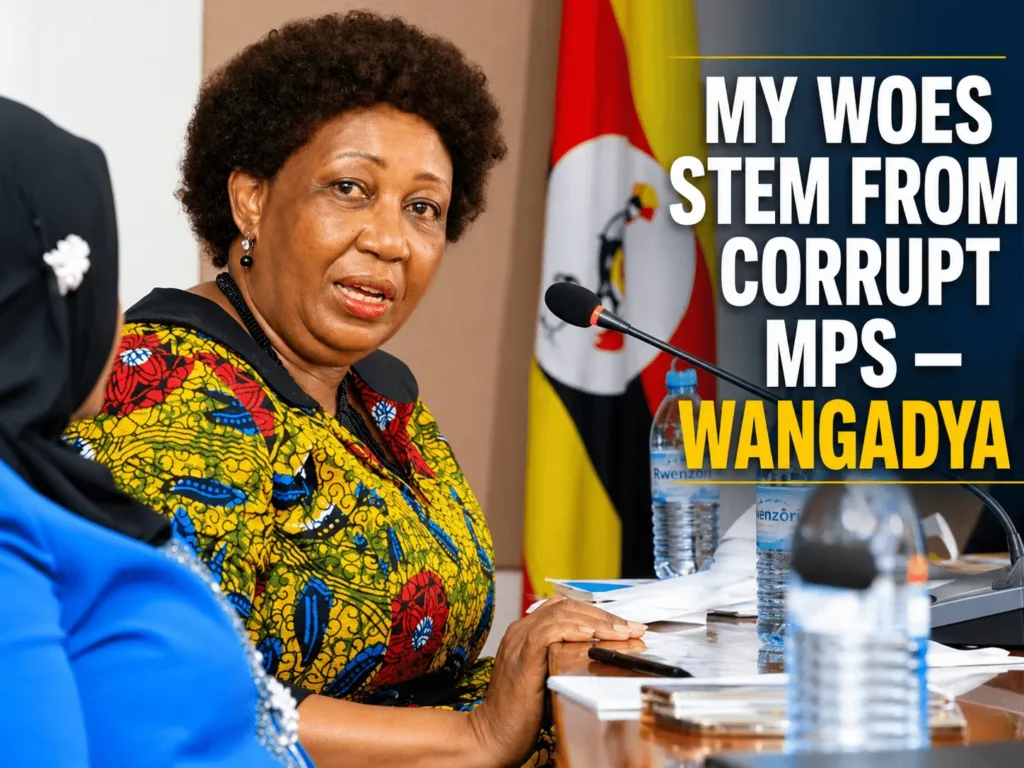
Uganda Human Rights Commission chairperson Mariam Fauzat Wangadya has accused lawmakers she reported to President Yoweri Museveni over an alleged budget kickback of being behind the difficulties she is facing at the commission.
Wangadya made the allegations during proceedings before Parliament’s Legal and Parliamentary Affairs Committee chaired by Bugabula North MP John Teira. The committee held hearings on July 23 and July 24, 2026, as it investigated the worsening leadership dispute within the constitutional body.
An emotional Wangadya broke down while defending her leadership and responding to allegations raised by some commissioners.
She told legislators that the hostility against her intensified after she informed President Museveni about what she described as “syndicated grand corruption” involving the commission’s budget.
Wangadya said her experience could discourage other public officials from reporting suspected corruption.
“I am here precisely because of that, nothing else,” she told the committee.
The dispute dates back to 2024, when Wangadya reported then MPs Paul Akamba, Yusuf Mutembuli and Cissy Namujju over allegations that they had demanded a 20% kickback in exchange for helping the UHRC secure an increased budget.
Prosecutors alleged that the demand was made during a meeting at Hotel Africana in Kampala. The investigation reportedly relied on audio recordings, telephone data, CCTV material and forensic examination of mobile phones.
The three legislators denied wrongdoing.
The Director of Public Prosecutions discontinued the criminal proceedings through a notice dated January 6, 2026, filed before the Anti-Corruption Division of the High Court. The withdrawal ended the case without a court determination on the guilt or innocence of the accused.
Wangadya told the committee that the withdrawal of the case was followed by intensified criticism and complaints against her.
She alleged that Akamba, Mutembuli and Namujju were working with some UHRC commissioners, including Simeo Nsubuga, Col. (Rtd) Steven Basaliza and Jacklet Atuhaire Rwabukurukuru, to undermine her leadership.
The claims remain allegations, and Parliament had not announced any findings linking the named politicians or commissioners to a coordinated campaign against Wangadya by July 24.
Responses from Akamba, Mutembuli, Namujju and the three commissioners to Wangadya’s specific retaliation allegation had also not been included in the official parliamentary updates reviewed for this article.
Commissioners reject ‘political rejects’ label
The parliamentary inquiry followed complaints by Nsubuga and Basaliza, who accused Wangadya of publicly referring to former politicians appointed to the commission as “political rejects.”
The commissioners rejected the description and demanded an apology, arguing that their appointments were based on their qualifications and experience rather than their previous political positions.
Basaliza also told the committee that some of Wangadya’s public statements had caused distress to his family.
Wangadya said she had attempted to hold reconciliation talks with the dissatisfied commissioners but had not received a positive response.
She left it to the parliamentary committee to determine whether their damaged working relationship could still be repaired.
Wangadya remains UHRC chairperson
Wangadya submitted a notice expressing her intention to resign to President Museveni on July 6, 2026, citing the working environment at the commission.
However, Attorney General Sam Mayanja told Parliament on July 15 that the notice did not amount to an effective resignation because it had not been formally accepted by the appointing authority.
“As matters stand, she remains the substantive Chairperson of the Commission,” Mayanja told Parliament.
Wangadya told the committee that the communication had been intended to remain confidential and declined to discuss its contents extensively after it was leaked to the public.
Parliament’s official account of the July 23 proceedings said the Legal and Parliamentary Affairs Committee questioned Wangadya over allegations that she had handled some human rights complaints without adequately involving other commissioners.
Wangadya defended the closure of some complaints, arguing that certain convicted offenders were using human rights cases to avoid responsibility for serious crimes.
Several MPs challenged her reasoning, saying the constitutional rights of suspects and convicted persons must still be respected. Committee chairperson John Teira directed Wangadya to submit written responses to the issues raised by legislators.
Kaheru questioned over vehicle and generator
During the proceedings, MPs also questioned UHRC commissioner Crispin Kaheru about his use of a commission vehicle and a standby generator valued at Shs44m.
Kaheru denied irregularly taking possession of the vehicle. He said he formally requested another vehicle from the accounting officer because his assigned official car had repeatedly broken down.
He told the committee that he returned the vehicle after the matter attracted public attention.
Regarding the generator, Kaheru said it was procured under a programme intended to establish secure off-site workstations for the UHRC chairperson and commissioners.
He said the programme was supported by the Government and GIZ and maintained that the generator had not been acquired as a personal benefit.
MPs nevertheless questioned how equipment procured for official use ended up at his home.
UHRC subsequently issued a statement rejecting claims that Kaheru had irregularly possessed the two assets. The commission said the vehicle and generator were assigned to him through established administrative procedures while he performed his official duties.
UHRC added that Kaheru had voluntarily returned both items to the commission in the interest of institutional harmony.
Parliament examines wider UHRC dysfunction
The Legal Committee proceedings came as Parliament conducted a separate examination of the commission’s governance and financial management.
During a COSASE meeting on July 22, UHRC officials acknowledged that the commission had not held a formal meeting since March 2026, although such meetings are expected to guide its major decisions.
Parliament was also told that UHRC tribunal sessions had not been held since December 2025 after the commission exhausted the budget allocated for hearings.
COSASE members questioned how the institution had continued exercising its constitutional mandate without regular commission meetings and functioning tribunal sessions.
The parliamentary committees are expected to consider the submissions from Wangadya, the commissioners, accounting officers and other officials before making recommendations on the future management of the commission.