
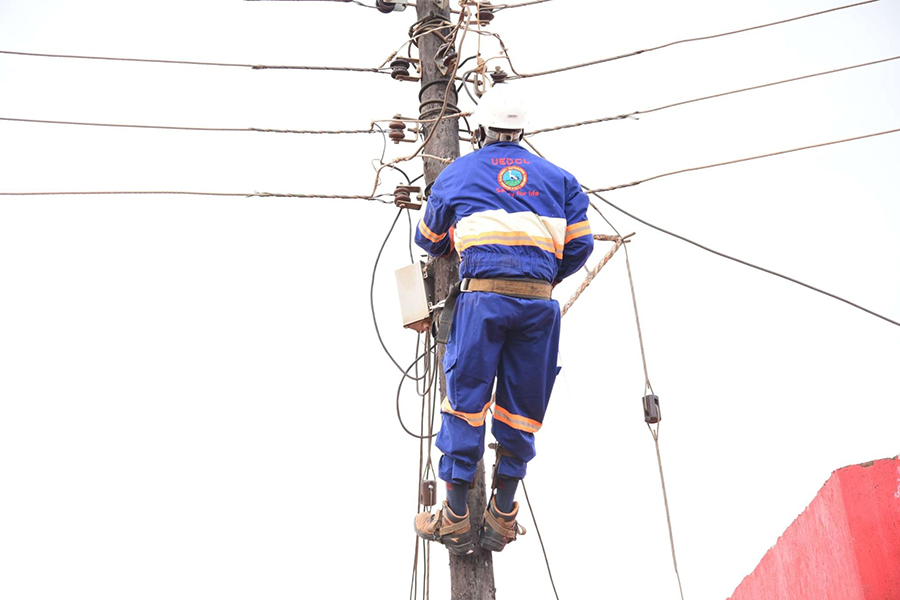
The Uganda Electricity Distribution Company Ltd has terminated the contracts of seven senior managers who were first sent on forced leave in May.
The managers were viewed internally as loyalists of former Managing Director Paul Mwesigwa, who was also sent on forced leave in April.
According to inside accounts, UEDCL’s interim management summoned the group on Monday to collect letters communicating the end of their employment.
The affected officials are Ms Justine Nakagiri Ssemwanga, head of internal audit; Mr Boniface Barongo, head of human resources and administration; and Ms Beatrice Tumuheirwe, manager for HR business partner.
Others are Mr Jonan Kiiza, head of corporate and stakeholder affairs; Mr Protaze Tibyakinura, chief of engineering and technical services; Ms Barbrah Kyomuhendo, head of technology and applications; and Mr Geoffrey Musafu, manager of applications.
Managers were first sent on forced leave
The seven officials were first sent on forced leave on May 6.
The company said the leave would allow investigations into “workplace culture” and poor performance after UEDCL reassumed management of Uganda’s power distribution infrastructure from Umeme Ltd on April 1, 2025.
The group was initially sent away for one month. The leave was later extended in June.
According to accounts from within the company, the managers were later told to pick termination letters after June 30, when their current contracts were due to expire.
The termination was reportedly handled under guidance from the Ministry of Public Service on the merger of government agencies and departments under the Rationalisation of Government and Public Expenditure programme, commonly known as RAPEX.
Under the arrangement, the Ministry of Public Service placed a hiring freeze on non-critical staff in targeted agencies and departments.
Employees in the three electricity companies — Uganda Electricity Generation Company Ltd, Uganda Electricity Transmission Company Ltd and UEDCL — were given two-year contracts, renewable upon expiry.
While the managers had first been sent on forced leave, insiders said the RAPEX technicality was invoked to end their contracts.
Power sector merger remains unclear
UEGCL, UETCL and UEDCL were created after the unbundling of the former Uganda Electricity Board.
That restructuring followed the enactment of the Electricity Act in November 1999.
The Electricity Amendment Act, 2022 provides for the re-merging of the three companies into a vertically integrated Uganda National Electricity Company.
Under the proposed structure, UNEC would have departments for generation, transmission and distribution. The Electricity Regulatory Authority would remain a standalone regulator.
Cabinet had earlier guided that UNEC should operate as a joint venture, with government holding 51 percent and a private player holding 49 percent.
However, the implementation of the merger appears to have slowed.
In 2024, President Museveni reportedly directed that a contract be awarded to SMS Construction to build a major office block for UETCL on 3rd Street in Industrial Area.
The project is reportedly behind schedule and has attracted controversy.
UEDCL currently occupies a major office block in Nakasero, while UEGCL continues to rent premises in Bukoto.
Despite the legal framework for the merger, sources familiar with the sector say the plan appears to have been put aside for now.
Claims of internal tensions at UEDCL
Inside sources also claim that some government officials and commission agents continue to search for another concessionaire to partner with UEDCL.
Some insiders allege that several problems affecting the distribution side of the electricity business border on internal sabotage.
They also claim some disruptions were deliberately inflicted, including alleged use of online influencers to amplify public anger over power outages.
Power outages have persisted, and service delivery has not improved significantly in parts of the Greater Kampala Metropolitan area.
Several substations are also yet to be rehabilitated.
The online criticism reduced slightly after Mr Mwesigwa’s removal, according to insiders.
Some sources say Mr Mwesigwa had made enemies on several fronts, partly because of stalled procurement tenders linked to companies with political backing.
Mwesigwa’s fate remains uncertain
Former Energy Minister Ruth Nankabirwa sent Mr Mwesigwa on forced leave on April 29.
The decision was reportedly made on the orders of President Museveni, who had raised concerns about UEDCL’s operations.
One concern was the reported rise in electricity losses from 15 percent to 19 percent after UEDCL started operating the national distribution network on April 1, 2025.
Two months later, insiders said UEDCL appeared stuck on Mr Mwesigwa’s fate.
They said there is no fixed duration for forced leave under the Employment Amendment Act.
Attempts to get a comment from UEDCL management were unsuccessful by press time.
The acting Chief Executive Officer, Ms Joselynne Rwakakooko, is reportedly attending a conference in South Africa.
Mr Isaac Mufumbiro, the head of strategy, compliance and regulation, did not respond to queries.
He said he was in hospital and promised to call back, but had not done so by press time. Further attempts to reach him were unsuccessful.
Acting appointments raise questions
According to UEDCL’s human resource organogram, Mr Mufumbiro ranks among mid-level managers.
His position is at the same level as the head of projects and construction, head of human resources, head of corporate and stakeholder affairs, and head of procurement.
Above that level are six senior officers at the rank of chief.
Insiders say the decision to appoint Mr Mufumbiro as acting CEO, despite the presence of senior officers above him, has deepened internal unease.
In the May reshuffle, Mr Isaac Katewanga was named chief commercial officer, replacing Ms Rwakakooko.
The changes also saw former Umeme staff take up key positions at UEDCL.
Mr Steven Illungole replaced Mr Kiiza, while Mr Sylver Hategekema replaced Mr Tibyakinura.
Mr Samuel Omoding replaced Mr Barongo, and Mr Nickson Ahabwe replaced Ms Nakagiri Ssemwanga.
Mr Richard Opiyo replaced Ms Kyomuhendo, Mr Francis Damulira replaced Mr Musafu, and Ms Christine Atuhaire replaced Ms Tumuheirwe.
All the new office holders were appointed in acting capacity.
Nankabirwa defended Mwesigwa’s removal
Speaking during UEDCL’s 21st Annual General Meeting in May, Ms Nankabirwa defended Mr Mwesigwa’s removal.
Ms Nankabirwa, who was later dropped in the Cabinet reshuffle and appointed senior presidential advisor, said UEDCL had recorded some financial improvement.
However, she said that progress had been overshadowed by persistent customer complaints and electricity connection challenges.
Umeme operated Uganda’s distribution infrastructure from 2005 until March 31, 2025.
By the time its concession ended, energy losses averaged 16 percent, down from 38 percent in 2005.
UEDCL had been given a target to reduce losses further to 13.7 percent.
However, according to Ms Nankabirwa’s April 30 letter, losses had instead increased by about six percentage points.
By comparison, Kenya and Tanzania, which have more installed electricity capacity than Uganda, record losses of 22 percent and 17.9 percent respectively.
Meanwhile, preliminary arbitration proceedings in London between Umeme Ltd and the government over payment of the $234.7 million buyout are scheduled to begin later this month.