
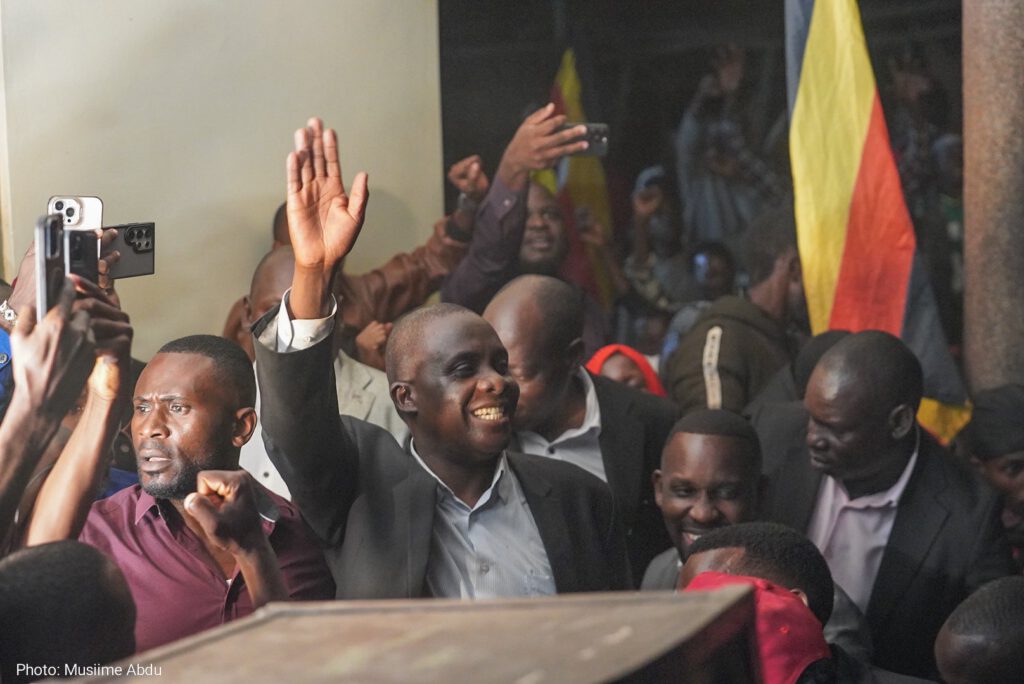
Parliament has directed the government to establish the whereabouts of former Butambala County MP Muhammad Muwanga Kivumbi following his alleged re-arrest shortly after securing court bail.
Leader of the Opposition Joel Ssenyonyi raised the matter during Tuesday’s parliamentary sitting as an issue of national importance.
He said Kivumbi’s family and political colleagues had failed to locate him for four days.
The government acknowledged the seriousness of the allegations and promised to present Parliament with a comprehensive response.
Ssenyonyi told Parliament that Kivumbi secured bail on Thursday, July 10, 2026, in a criminal case in which he had stood surety.
He said police officers, accompanied by military personnel, intercepted Kivumbi the following day as he travelled from Butambala to Kampala.
According to Ssenyonyi, the officers allegedly forced the former MP into a white Toyota Hiace commonly described as a “drone.”
“Mr Speaker, from Friday up to today, Tuesday, his family and we, his colleagues, have been looking for him. We do not know where Hon. Muhammad Muwanga Kivumbi is,” Ssenyonyi told Parliament.
He asked the government to address two concerns.
“First, where is Hon. Muhammad Muwanga Kivumbi? Second, is this now the new normal of how government conducts arrests?”
Ssenyonyi said the government must explain whether security agencies had detained Kivumbi and identify the place where he was being held.
Opposition leader cites constitutional protections
Ssenyonyi argued that Uganda’s Constitution provides clear procedures for arresting and detaining suspects.
He cited Article 23, which protects the right to personal liberty.
The provision requires authorities to inform arrested people immediately about the reasons for their arrest. It also requires detention in a legally authorised facility.
Authorities must produce an arrested person before a competent court within 48 hours unless they release the person earlier.
Ssenyonyi also referred to the Human Rights Enforcement Act, 2019. The law allows courts to provide remedies where state agencies violate constitutional rights.
Such violations may include unlawful detention and enforced disappearance.
The opposition leader questioned reports suggesting that authorities targeted Kivumbi over statements he allegedly made after his release.
“If someone believes Hon. Kivumbi committed an offence through his speech, who determines that? It is the courts of law – not security agencies,” he said.
Ssenyonyi accused the government of demanding that citizens respect legal procedures while security agencies allegedly ignored the same standards.
“Government consistently tells citizens not to take the law into their own hands but to hand suspects over to police. Why then does government fail to follow the very procedures it preaches? We cannot continue preaching water while drinking wine.”
He said authorities should arrest Kivumbi through established legal procedures if they suspect him of committing another offence.
“It has now been four days, Mr Speaker, and we still do not know where Hon. Muwanga Kivumbi is.”
Previous post-bail arrests cited
Ssenyonyi linked Kivumbi’s reported disappearance to previous arrests of opposition politicians after courts granted them bail.
He cited the September 2021 re-arrests of former MPs Muhammad Ssegirinya and Allan Ssewanyana outside Kigo Prison.
Security personnel detained the two politicians shortly after their release on bail.
Ssenyonyi also referred to the June 2024 arrest of former Busiki County MP Paul Akamba.
Armed operatives reportedly detained Akamba within court premises after he secured bail.
Ssenyonyi said such cases raised concerns about respect for court decisions and the separation of powers.
“Have we now as a country departed from what the law clearly stipulates?” he asked.
Government asks for time to establish facts
Deputy Speaker Thomas Tayebwa, who chaired the sitting, referred the matter to Deputy Government Chief Whip Dr Walter Crispus Kiyonga.
Tayebwa said the issue extended beyond the Attorney General’s advisory responsibilities.
Kiyonga acknowledged the seriousness of the allegations but asked Parliament for more time to gather information.
“I have heard him clearly. For me to give you a fitting answer, I request that you allow me to return tomorrow and provide a comprehensive response.”
Ssenyonyi accepted that the government might need time to establish Kivumbi’s location.
However, he demanded an immediate explanation of the government’s policy on arrests conducted in the manner alleged.
“Perhaps the deputy Government Chief Whip needs time to find out where Hon. Kivumbi is because he was not the one who picked him up. We hope tomorrow Government will tell us where he is.”
“But my second concern is about the new normal. The country needs guidance. Is this now how arrests are conducted? That question should not have to wait until tomorrow.”
Attorney General says constitutional order remains
Tayebwa then invited Attorney General Sam Mayanja to respond to the House.
Mayanja rejected the suggestion that Uganda had adopted a new approach to arrests.
“The terms ‘new normal’ and ‘old normal’ do not exist in my legal vocabulary.”
He said Uganda remained governed by the Constitution.
“As far as I know, this Parliament and this country remain under the dispensation of constitutionalism.”
Mayanja cited Article 23 of the Constitution while holding up a copy of the document.
He said the provision required authorities to detain arrested people only in legally recognised facilities.
It also requires officers to explain the reasons for an arrest in a language the suspect understands and inform the person about the right to legal representation.
However, the Attorney General said the government had not established the circumstances surrounding Kivumbi’s reported arrest.
“I do not have the facts regarding the alleged arrest. All I know is that we remain under a constitutional dispensation and Mr Kivumbi’s rights are protected.”
He promised that the government would return to Parliament with further information.
“Tomorrow is not far. We shall return before Parliament with all the facts and ensure that the Constitution, which we all swore to protect, is indeed protected.”
Laws protect detainees from unlawful treatment
Article 23 of the Constitution guarantees personal liberty, while Article 24 prohibits torture and cruel, inhuman or degrading treatment.
The Police Act and Criminal Procedure Code Act also regulate arrests and the treatment of suspects.
Uganda is further bound by international human rights instruments, including the International Covenant on Civil and Political Rights and the African Charter on Human and Peoples’ Rights.
The instruments require authorities to follow due process and bring detainees promptly before a competent judicial authority.
Parliament now awaits the government’s promised explanation about whether security agencies arrested Kivumbi and where he is being held.