
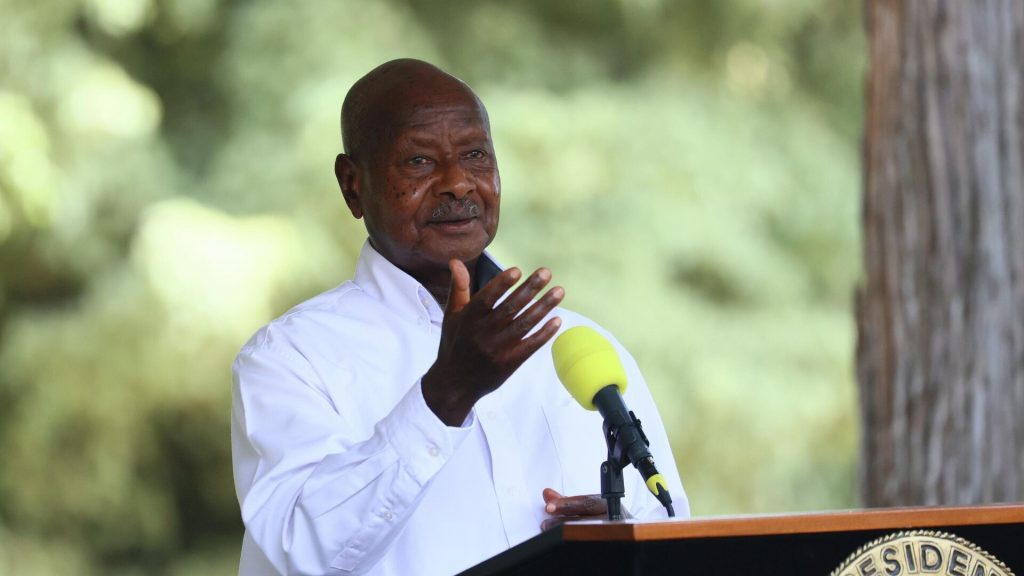
KAMPALA — President Yoweri Museveni has urged newly sworn-in Cabinet ministers to make the fight against corruption a central part of their work as government begins a new term.
Museveni made the remarks while opening a nine-day leadership retreat for the ministers.
He told the ministers that public office should be measured by service, accountability and results.
“Leadership is not all about occupying offices, but discovering your responsibility to the people. Ugandans expect tangible results rather than empty promises,” Museveni said.
The President said corruption remains one of the biggest threats to Uganda’s development agenda.
Corruption Losses Put Government Under Pressure
Uganda loses huge sums of public resources to corruption, according to the Inspectorate of Government’s June 2024 report.
The report estimated annual corruption-related losses at nearly Shs10 trillion.
It also calculated that Shs9.144 trillion had been lost through different forms of public sector leakages during the periods of July to December 2023 and January to June 2024.
The biggest losses were linked to environmental resources, estimated at Shs2.28 trillion.
Other losses included Shs1.46 trillion in education hours lost to students, Shs859.2 billion in corruption related to contract royalties, Shs762.90 billion in bribery involving judges and Shs614.41 billion in procurement-related corruption.
Museveni told the ministers that such leakages weaken government programmes and slow national progress.
Museveni Pushes Wealth Creation Agenda
The President also reminded ministers that the historical mission of the National Resistance Movement government is socio-economic transformation.
He said leaders must help move households out of subsistence production and into the money economy.
“We cannot continue to have people trapped in subsistence production. Our mission is to move every household into the money economy through commercial agriculture, manufacturing, services and ICT,” Museveni said.
He added that leaders must guide citizens toward wealth creation, value addition and prosperity.
“Leaders must guide the people towards wealth creation, value addition, and prosperity. We must build a middle class and a skilled working class. That is the benchmark by which leadership should be judged,” he said.
Museveni named his new Cabinet on May 26 for the new term.
The National Resistance Movement is expected to implement a new manifesto under the theme: “Protecting the gains as we make a qualitative leap into a high middle-income status.”
NRM Manifesto Focuses on Seven Pillars
The new NRM manifesto focuses on seven key pillars.
They include infrastructure development through expansion of roads, electricity, railways, air transport, schools and health centres.
The manifesto also prioritises wealth creation through programmes such as the Parish Development Model, Operation Wealth Creation and Emyooga.
Other areas include job creation through factories, commercial agriculture and services.
The manifesto also focuses on market creation, service delivery, unity and political stability.
Government says these priorities will support internal, regional, continental and international trade.
Tenfold Growth Strategy Remains Central
The manifesto aligns with the Tenfold Growth Strategy, which government launched in 2023.
The strategy seeks to expand Uganda’s economy from about $50 billion to $500 billion by 2040.
Government has focused the plan on four priority sectors, commonly referred to as ATMS.
These are agro-industrialisation, tourism, mineral development, and science, technology and innovation.
Government has also aligned budgets and development plans to these priorities.
The Fourth National Development Plan, which runs from Financial Year 2025/2026 to Financial Year 2029/2030, aims to accelerate Uganda’s socio-economic transformation.
The plan seeks to support tenfold economic growth by doubling the size of the economy every five years.
Its objectives include increasing value addition, strengthening the private sector, creating jobs and improving productive infrastructure.
It also seeks to improve productivity, social well-being and the role of the State in guiding development.
Alupo Calls for Timely Implementation
Vice President Maj (rtd) Jessica Alupo also addressed the retreat.
She repeated the government’s position on zero tolerance for corruption, inefficiency and delays in implementation.
Alupo said Cabinet is committed to timely delivery of government programmes and presidential directives.
She also highlighted the National Development Plan and the 2026–2031 development framework.
She said these frameworks are intended to accelerate Uganda’s transition to upper middle-income status and promote sustainable economic growth.
Alupo listed agro-industrialisation, tourism, science, technology and innovation among the key priority areas.
She also pointed to value addition, export promotion and import substitution as central to the government’s agenda.