
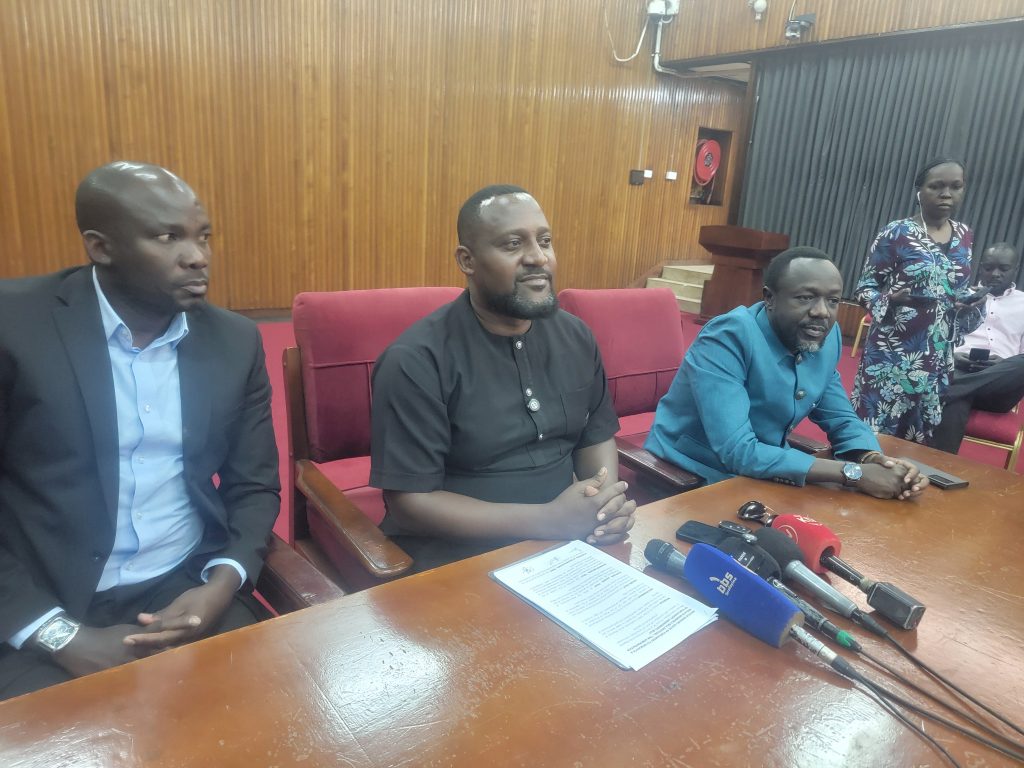
A move to change how the Leader of Opposition in Parliament is selected has drawn sharp criticism from legal and political observers, who warn that the proposal could face serious legal hurdles and weaken multiparty democracy.
Buyaga West MP Dennis Namara of the National Resistance Movement (NRM) on Wednesday, June 24, formally notified Parliament of his intention to introduce a Private Member’s Bill to amend the Administration of Parliament Act.
The proposed amendment comes days after Gen Muhoozi Kainerugaba, the Chief of Defence Forces and chairperson of the Patriotic League of Uganda (PLU), warned the current Leader of Opposition, Joel Ssenyonyi, that he would lose his seat “very soon.”
PLU members have remained optimistic about the effort. They insist they can find a legal route to remove Mr Ssenyonyi, who is also the Nakawa West MP and a member of the National Unity Platform (NUP).
However, constitutional lawyers and political analysts have described the push as ill conceived. Some argue that it is aimed at weakening the Opposition in Parliament.
Walubiri warns of weakening Opposition
Constitutional lawyer Peter Walubiri criticised the proposal, saying Uganda needs a strong Opposition at a time when concerns over rule of law remain high.
“The country is already suffering from the worsening rule of law and the only hope we had was strong Opposition which they want to weaken by choosing the Leader of Opposition. As a country we are doomed…,” Mr Walubiri said.
Dr Juma Kakuba Sultan, a lecturer of Political Science at Kyambogo University, questioned why the NRM was leading a legislative process that directly affects the Opposition.
“Ordinarily complaints would have come from the Opposition but what we are seeing is the Opposition being weakened because the NRM will have an influence on the person who shall become the Leader of Opposition and this weaken democracy. There is no good intention in this entire Bill because after weakening the Opposition, nothing good will come from that House,” he said.
Namara seeks leave to table amendment
Mr Namara’s notice was addressed to Speaker Jacob Oboth-Oboth and copied to the Deputy Speaker and Clerk to Parliament.
“In accordance with Rule 58 of the Rules of Procedure of Parliament, I hereby give notice of my intention to move a motion for leave of the House to introduce a Private Member’s Bill entitled ‘The Administration of Parliament (Amendment) Bill, 2026,’” the notice reads.
The Clerk to Parliament, Mr Adolf Mwesige, confirmed receiving the notice.
“I have forwarded it to the Speaker who has the powers to put it on the Parliament Order Paper for further management,” he said.
At the same time, Speaker Oboth-Oboth was presiding over the handover of the PLU secretary general’s office. Tingey County MP Fadil Twalla took over from Kasambya County MP Daudi Kabanda.
Current law gives largest Opposition party power
Under the current arrangement, the Opposition party with the largest number of MPs nominates the Leader of Opposition. The Speaker then formally informs the House.
Article 82A of the Constitution, introduced by the Constitution (Amendment) Act, 2005, establishes the Office of the Leader of Opposition.
The Administration of Parliament (Amendment) Act, 2006, provides the operational framework. It vests the power to appoint the Leader of Opposition in the Opposition party with the greatest numerical strength in Parliament.
Mr Ssenyonyi was retained as Leader of Opposition after serving in the same role during the latter half of the previous Parliament.
PLU push follows Muhoozi-Ssenyonyi exchange
The latest push follows a public exchange on X between Gen Muhoozi and Mr Ssenyonyi.
The exchange escalated after Mr Ssenyonyi addressed journalists at Parliament last week and condemned the arrest and detention of former Kampala Lord Mayor Erias Lukwago.
Soon after, Gen Muhoozi posted on X that he wanted a new Leader of Opposition in Parliament.
“I want a new Leader of the Opposition in Parliament. And I will get him. He will be endorsed by me,” Gen Muhoozi posted.
He later said he had instructed PLU MPs to study how Mr Ssenyonyi could be removed “as soon as possible.”
Mr Kabanda responded by assuring the PLU chairperson that “two weeks are enough.”
Namara says law has a gap
Mr Namara told journalists at Parliament that his proposal would benefit all Opposition parties, including NUP.
He argued that the current law does not provide enough grounds for removing a Leader of Opposition once selected.
“The current law has a lacuna, because the Parliament, the people who elected him, the Opposition members of Parliament who selected this particular Leader of Opposition cannot remove that member from being a Leader of Opposition,” he said.
He said the law currently allows removal mainly where the sponsoring party withdraws the office holder, where the person ceases to be an MP, or where the party represented no longer has membership in Parliament.
“But is that one enough? The President of Uganda, under the Constitution can be removed by Parliament. You are aware that the Speaker of Parliament, his deputy, Cabinet ministers, and even members of Parliament can be removed. What about the Leader of Opposition? Who is at the level? Because the law provides that he is at the level of Cabinet,” Mr Namara said.
Previous Bill was withdrawn after objections
Mr Namara’s move revives a proposal that failed in the previous Parliament.
On August 29, 2024, Mityana South MP David Lumu secured leave to introduce the Administration of Parliament (Amendment) Bill, 2024.
That Bill also sought to change the process for selecting the Leader of Opposition and other parliamentary positions reserved for the Opposition.
During committee scrutiny, several political parties, including the Forum for Democratic Change, Uganda Peoples Congress and Alliance for National Transformation, rejected the proposal.
They argued that it had been brought in bad faith, would undermine multiparty democracy, and was intended to weaken the Opposition.
Parliament later withdrew the Bill on March 12 following widespread opposition.
NRM numbers give proposal political weight
The NRM holds a large majority in the 12th Parliament, with 372 MPs.
NUP, the largest Opposition party and Mr Ssenyonyi’s political home, has 49 MPs. Uganda Peoples Congress has 12, Forum for Democratic Change has nine, Democratic Party has six, People’s Front for Freedom has two, and Alliance for National Transformation has one.
There are also 68 Independent MPs, with 42 described as leaning toward the NRM.
Supporters of the proposed amendment would still have to navigate parliamentary procedures and legal scrutiny before any change can take effect.