
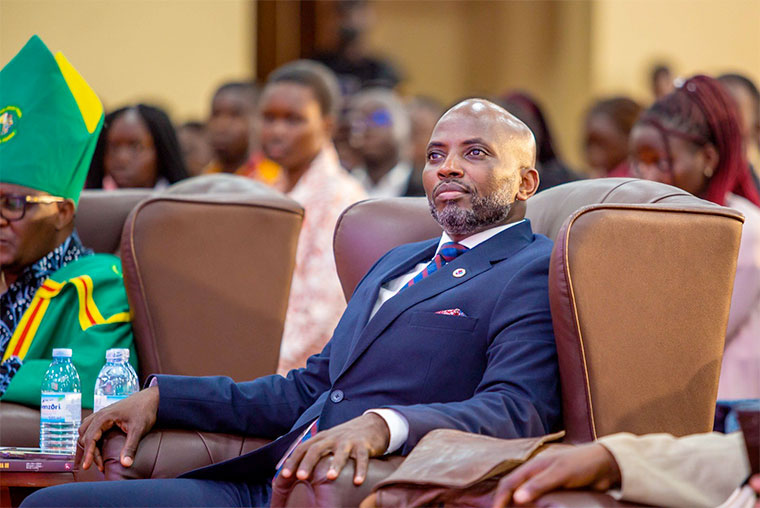
Details in a 2018 book by Dr Lawrence Muganga have added fresh attention to questions about his citizenship status.
Dr Muganga, the embattled State Minister for Internal Affairs-designate, wrote that his parents fled Rwanda for Uganda in 1959. He also stated that they returned to Rwanda in 1996.
President Museveni appointed Dr Muganga to the Internal Affairs docket. However, Parliament’s Appointments Committee rejected him last week. The committee questioned whether he held only Ugandan citizenship, as required under immigration laws.
Dr Muganga has denied holding three citizenships of Uganda, Rwanda and Canada. He said his parents were born in Uganda and buried in Mukono District.
Details from Muganga’s book
In his 2018 book, You Can’t Make “Fish Climb Trees: Transform the Art of Learning for Maximum Success Beyond the Classroom with Authentic and Student-Centred Schooling, Dr Muganga gave a different account of his family background.
“I was born, raised and educated in Uganda where my parents fled from the ethnic violence in Rwanda in 1959. As members of the Tutsi population, my parents felt oppressed in Rwanda, yet were accepted by the government of Uganda,” Dr Muganga wrote.
He also described himself as a child of a refugee.
“Like many other children of Rwandan origin whose parents had sought refuge and lived in Uganda since the 1950s, my first experience of school was as a refugee student. The conditions were difficult,” he wrote.
Dr Muganga said his father studied up to primary four in Rwanda before he left school to care for his grandfather’s cattle.
He wrote that his parents spent time in an unnamed refugee camp. They later left the camp and worked on a farm owned by a Ugandan. His mother sold leftover milk to support him and other family members.
Birthplace and early education
The book does not state where Dr Muganga was born. However, in an interview with Mr Kamara on NTV’s On the Spot, he said he was born in Butaleja District in eastern Uganda.
His Ugandan passport, however, indicates that he was born in Mukono District.
According to Dr Muganga, his father wanted his mother to allow him to leave school and look after cattle. His mother, who had studied up to Primary Two, refused.
He said she took on blue-collar jobs to raise his school fees. Dr Muganga also kept rabbits to pay part of his primary school fees.
He later joined Makerere University. In 2002, he graduated with a Bachelor of Arts in Economics.
“In 1996, my family had returned to Rwanda, and, upon graduating with a Bachelor of Arts in Economics, I followed them,” he wrote.
Rwanda passport and work history
Dr Muganga told Daily Monitor in 2021 that he got a Ugandan passport before travelling to Rwanda. It remains unclear what his Ugandan citizenship status was at the time.
After arriving in Rwanda, he processed a Rwandan passport. He said he received it in one day after convincing junior immigration staff to let him meet the immigration director.
The director, who was also a military officer, later helped him find work.
The military officer arranged for him to teach history to 32 soldiers in Rwanda. He taught them for two years. Some of the soldiers later connected him to other jobs.
“One of the military officers found me a job as a loans officer in a military bank. Then, another former student referred me for a job as an auditor in RRA, showing me that connections with the military can be very helpful in finding work,” he wrote.
After three years at the Rwanda Revenue Authority, Dr Muganga received a World Bank scholarship. He returned to Makerere University for a master’s degree programme.
“When I graduated, I was one of the few Rwandese students who had studied economic policy development. I returned to RRA, and when it came to implement reform with the organisation, I was seconded to the commissioner general’s office to support the international consultant advising RRA about reform and modernisation strategy,” he wrote.
He later joined the Human Resources and Institutional Capacity Development Agency in Rwanda. He said he returned to Uganda in 2009.
Canada citizenship and renunciation claims
In 2012, Dr Muganga moved to Canada to pursue his PhD. He later obtained Canadian citizenship.
He said he returned both his Rwandan national ID and passport to the Rwandan embassy in Ottawa, Canada. He also informed the embassy that he had acquired Canadian citizenship.
Dr Muganga said he came back to Uganda in 2019 after an invitation from Uganda government officials.
In 2024, he notified Uganda Immigration about his dual citizenship involving Uganda and Canada. He said officials told him they had detected that he was also a Rwandan citizen.
“I explained to them how I got Rwandan citizenship. They were not convinced. So, I went to the Rwanda embassy and submitted the documents renouncing their citizenship. I returned to Uganda Immigration and they then gave me dual citizenship,” he said over the weekend in Seeta, Mukono District.
Dr Muganga insists he did not obtain dual citizenship illegally.