
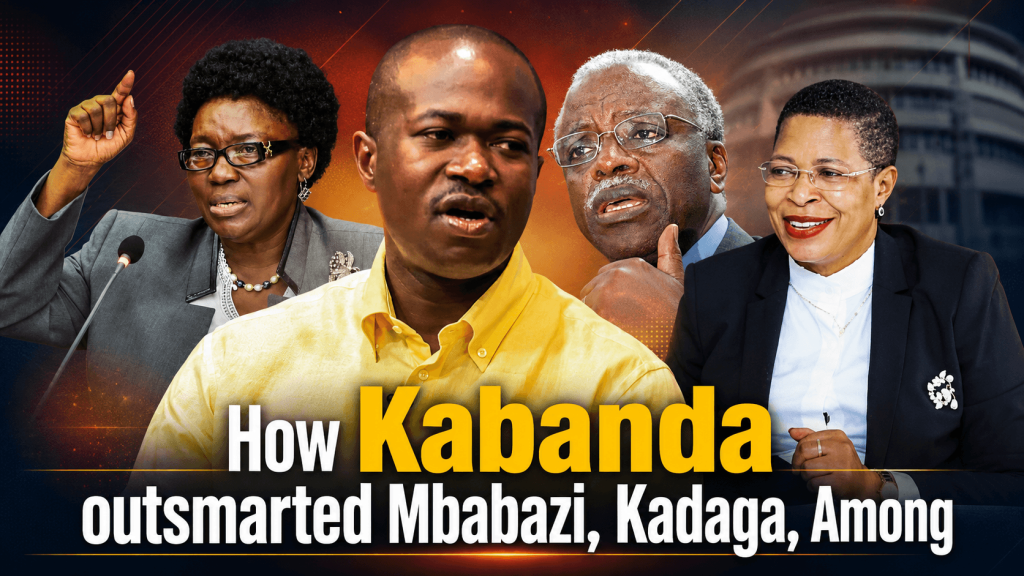
Kasambya County MP Daudi Kabanda has built a political career around reading power shifts inside the National Resistance Movement and positioning himself at the centre of decisive internal battles.
Kabanda, who holds a Senior Six certificate and a certificate in Journalism, has often faced criticism over his academic background. Health Minister Dr Chris Baryomunsi once described him as “one of the most intellectually ungifted Ugandans, with low levels of education.”
Kabanda does not present himself as highly educated. However, his political record shows a figure who has repeatedly moved early in factional contests and benefited from those decisions.
Early Education and Political Instincts
Kabanda dropped out of school in Senior Two but later returned to sit his Uganda Certificate of Education examinations. He had not attended class for two years but still obtained four credits.
“After the results came out, I asked whether they would permit me to go to A-Level. I was told I could proceed. So, I celebrated. I did not envisage a situation where people would laugh at my results because even those with whom I had done exams and who had been attending class, failed,” Kabanda said.
He later sat his Uganda Advanced Certificate of Education examinations after missing what would have been his Senior Five year. He obtained two principal passes.
Sembabule Factions and Kuteesa Camp
Sembabule District politics had long been divided between camps linked to former Foreign Affairs minister Sam Kuteesa and former Lwemiyaga County MP Theodore Ssekikubo.
Kabanda first aligned with Ssekikubo’s faction. He later crossed to the Kuteesa camp ahead of the January 2009 by-election in which Anifa Kawooya defeated Joy Kabatsi for the District Woman Representative seat.
The move gave him a job at Kuteesa’s Radio Mbabule. It also brought him closer to Kuteesa and helped him rise in youth politics.
In 2011, Kabanda became chairman of the Sembabule Youth Council. He also became secretary for publicity in the NRM Youth League.
Role in the Mbabazi-Museveni Power Struggle
By 2012, then Prime Minister Amama Mbabazi had gained influence among sections of the NRM Youth League. Pro-Mbabazi youth groups were attracting media attention.
Kabanda suspected that Mbabazi had presidential ambitions. He raised the matter with Kuteesa and suggested organising pro-Museveni youth.
“The media is reporting about pro-Mbabazi youth. Can’t we also have the pro-Museveni youth? But we first find out whether he wants to stand or not,” Kabanda told Kuteesa.
Kabanda later contacted Mbabazi. After a missed call and a text message, Mbabazi replied: “Hello, Comrade Kabanda. It is now late. Let us talk when we are all awake.”
The following day, Mbabazi granted him an appointment. The meeting took place on December 5, 2012, a day before Mbabazi travelled to the Vatican.
Kabanda said the meeting convinced him that Mbabazi planned to challenge President Museveni.
“I found ministers waiting for him. He had lined up ministers. They ushered me in immediately, and he saw me at before the ministers. If you are a Prime Minister, you are coordinating government programmes with the ministers. How would you leave ministers and meet a youth chairman of Sembabule District? It was enough to know that this man is going to stand [for president],” Kabanda said.
Mbabazi neither confirmed nor denied the claim.
Kabanda later became involved in efforts to weaken Mbabazi’s youth structures. In 2014, his group moved to convene a conference aimed at removing NRM Youth League leaders accused of supporting Mbabazi.
Museveni Steps Into Youth League Fight
President Museveni later directed then Inspector General of Police Gen Kale Kayihura to investigate the youth league tensions. Kayihura assigned Andrew Felix Kaweesi to handle the groundwork.
Museveni then spoke to Kabanda’s group. Ibrahim Kitata told him that their conference aimed to counter claims that NRM youth supported Mbabazi.
“The newspapers have been portraying a picture that all the youth in Uganda support Mr Mbabazi, but for us, we have called fellow youth leaders across the country for a Delegates Conference to suspend these people,” Kitata said.
Museveni asked them to postpone the meeting until he met Mbabazi. Delegates who had already arrived in Kampala were facilitated to return home.
Kabanda’s group was later suspended over claims that it had tried to divide Museveni and Mbabazi by planning an illegal delegates conference.
Museveni then invited the rival youth groups to State House on May 12, 2014. During the meeting, one youth reportedly told the President: “Your Excellency, we want you to leave that seat so that someone else sits in it.”
Kabanda reacted sharply.
“I am going to beat you up. You are not going to shout from here. How can you come here and insult the President? This is not your father’s home. Even when we address ourselves to Mr Mbabazi, we do so with respect,” he said.
Museveni then left the room briefly, telling the group: “Now that I also have my group, which is ready to fight for me, let me get out. I will come back.”
When he returned, Kabanda accused rival youth leaders of forming cliques against Museveni.
“Your Excellency, our Constitution is very clear. It does not allow cliques, but these people have been forming cliques to fight you. That is why we had organised ourselves to fight them,” Kabanda said.
Museveni responded: “Maybe from their positions, not from the party.”
Kabanda replied: “Yes, they can no longer hold positions in our party when they are hobnobbing with our opponents and enemies.”
The following day, NRM Youth League chairman Dennis Namara said the “small differences” had been resolved. He also declared that the Youth League supported Museveni as the party’s sole presidential candidate for 2016.
Mbabazi was later sacked as Prime Minister on September 18, 2014. On December 14, 2014, the NRM National Conference adopted constitutional amendments that changed how top party officials were selected.
Kabanda’s Role in Kadaga-Oulanyah Race
After winning the Kasambya County parliamentary seat in 2021, Kabanda joined MPs who backed Jacob Oulanyah against then Speaker Rebecca Kadaga.
Kabanda said he had initially supported Thomas Tayebwa for Deputy Speaker because of their personal relationship. However, he later changed position after speaking to Justine Lumumba Kasule.
“I was supporting Tayebwa as Deputy Speaker and not Anita Among because Tayebwa is the godfather of one of my sons. We had been interacting before I became an MP, but Justine Lumumba Kasule changed [persuaded] me. She said I could not support two men,” Kabanda said.
He said Kadaga had already declared plans to run as an independent. He argued that Tayebwa’s candidacy would have strengthened her camp.
Kabanda then joined politicians including Margaret Muhanga, Ruth Nankabirwa, Godfrey Kiwanda Suubi and Ofwono Opondo in campaigning against Kadaga.
On May 24, 2021, Oulanyah was elected Speaker of the 11th Parliament with 310 votes. Kadaga received 197 votes, while Ibrahim Ssemujju of the Forum for Democratic Change got 15 votes.
PLU Reversal and Among’s Exit From Speaker Race
Until May 11, 2026, Anita Among was widely expected to return as Speaker of the 12th Parliament.
She and Deputy Speaker Thomas Tayebwa had received backing from the NRM Central Executive Committee on January 27, 2026. The Patriotic League of Uganda also endorsed them on March 11, 2026.
PLU is associated with First Son and Chief of Defence Forces Gen Muhoozi Kainerugaba.
However, on May 12, 2026, PLU reversed its earlier endorsement. Kabanda read the revocation statement to the press.
Two days later, Among was reportedly advised not to contest in the Speaker’s race.
The development added another major political episode to Kabanda’s record. In less than 15 years, he has been involved in political fights linked to Mbabazi, Kadaga and Among.