
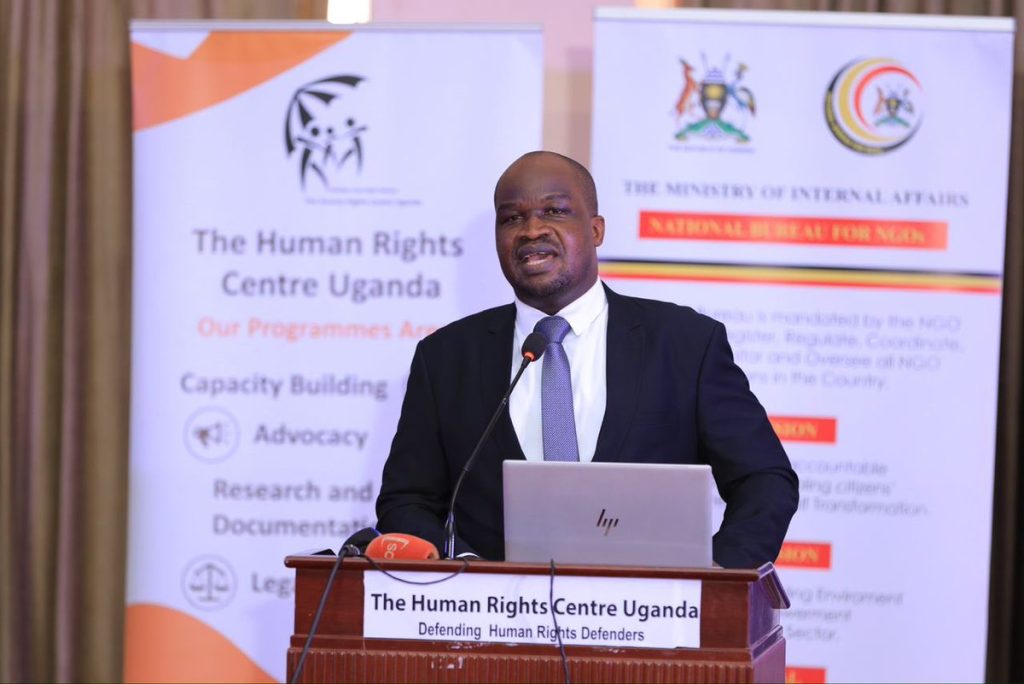
Lawyer Michael Aboneka has sued Mr Stephen Okello, the Secretary of the National Bureau for Non-Governmental Organisations, over the continued suspension of several civil society organisations.
The petition, filed in the High Court on June 15, challenges the legality of the suspension of non-governmental organisations and election-monitoring groups.
The affected organisations were ordered to stop operating days before the January 15 General Election.
Mr Aboneka accuses Mr Okello of acting outside the law. He also claims the suspensions were made without the authority of a legally constituted NGO Bureau.
Lawyer Challenges NGO Suspensions
In his petition, Mr Aboneka argues that the suspensions were arbitrary and violated due process.
He says the affected organisations were not given a fair hearing before the decision was taken.
The lawyer also argues that the move breached constitutional protections, including freedom of association and the right to fair administrative action.
“At the time of the suspension of the NGOs, there was no NGO Bureau constituted, and therefore the respondent (Mr Okello) acted on his own volition to effect the suspension,” Mr Aboneka states in the petition.
He further alleges that the decision ignored statutory requirements and the rules of natural justice.
“The respondent executed the impugned suspension in disregard of the law, the constitutional right to a fair hearing under Article 28 and rules of natural justice. The continued indefinite suspension of NGOs amounts to contempt of court as this was prohibited by the honourable court in Chapter Four Uganda versus Attorney General (Miscellaneous Cause No. 202 of 2021),” the petition reads in part.
Suspensions Issued Before Election
The case stems from a January 9 decision by the NGO Bureau to suspend at least 10 civil society organisations and election-observation groups.
The directive came six days before Ugandans went to the polls.
At the time, government authorities cited intelligence reports. They claimed the organisations were linked to activities considered prejudicial to national security.
The affected groups included Chapter Four Uganda, the Alliance for Election Finance Monitoring, Human Rights Network for Journalists-Uganda, the National NGO Forum, and the National Coalition of Human Rights Defenders.
However, Mr Aboneka says the organisations were not informed of the specific allegations against them.
He also says they were not given a chance to respond before the suspensions took effect.
Continued Closure Raises Rights Concerns
According to the petition, several affected organisations remain closed months after the suspension orders were issued.
Mr Aboneka argues that the continued closure undermines constitutionally protected rights and freedoms.
He says the suspensions violate citizens’ right to freedom of association under Article 29(1)(e) of the Constitution.
He also cites Article 38(2), which protects citizens’ right to participate in government affairs through associations.
The petitioner says civil society organisations play a key role in public accountability, access to information, and citizen participation.
He argues that prolonged suspension has denied Ugandans access to those services.
Access to Justice Cited
Mr Aboneka says he filed the case in the public interest.
He also raises concern about the effect of the closures on vulnerable and disadvantaged groups.
According to the petition, some of the suspended organisations provide legal aid, human rights advocacy, legal awareness, and representation.
The lawyer argues that closing such organisations weakens access to justice for indigent persons and communities.
He says many Ugandans rely on civil society groups for support they may not otherwise afford.
“The continued suspension of NGOs by the respondent (Mr Okello) is a continuous violation of the constitutional rights and freedoms; the freedom to a fair hearing guaranteed under Article 28; the right to fair and just treatment in administrative decisions guaranteed under Article 42; the right of citizens to participate in the affairs of government through associations guaranteed under Article 38(2); and the freedom of association guaranteed under Article 29(1)(e),” Mr Aboneka states in the petition.
Petitioner Seeks Court Orders
Mr Aboneka wants the High Court to declare that the suspension of the NGOs by Mr Okello was illegal, unlawful, and carried out without legal authority.
He also wants court to declare that closing organisations involved in legal aid and human rights work violates the constitutional right of access to justice.
In addition, the petitioner is seeking a permanent injunction.
He wants court to restrain Mr Okello from taking any action affecting NGOs unless such action is authorised by a legally constituted NGO Bureau.
The case is expected to renew debate about the relationship between government regulators and civil society organisations.
It also comes at a politically sensitive time, given the role of election observers and rights groups during polls.
By press time, Mr Okello, who is being sued in his personal capacity, had not filed a defence.
Court records also show that the matter has not yet been allocated a hearing date.